
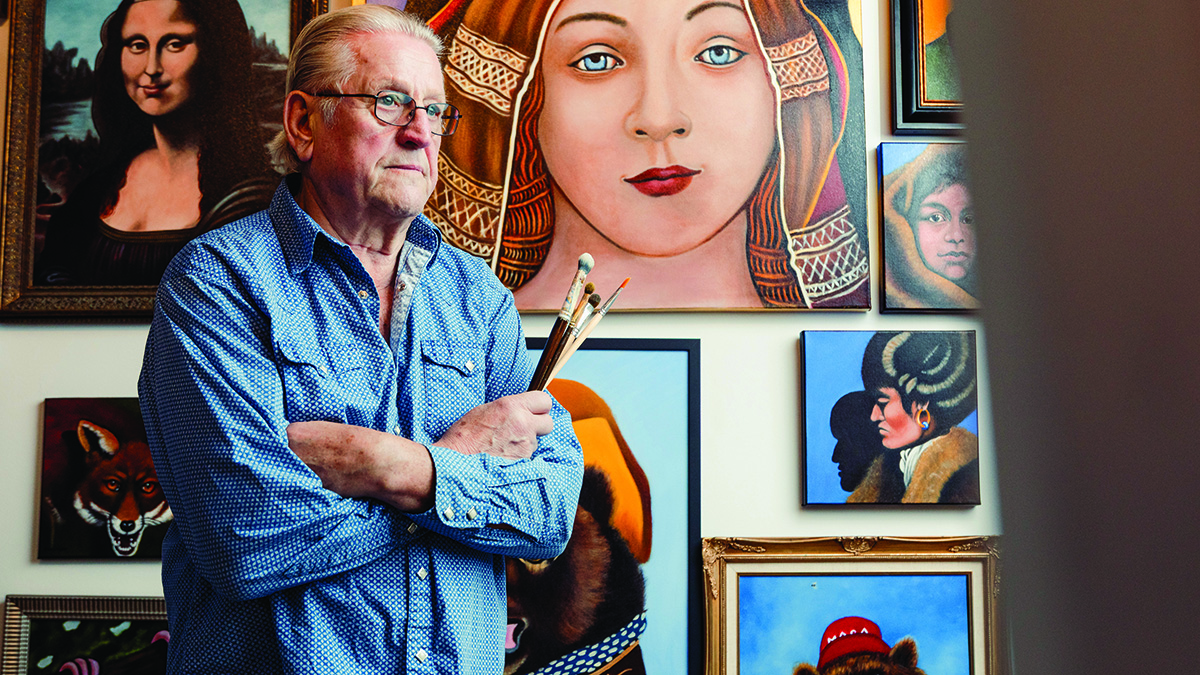
Painter Hans-Peter Bolz proves you’re never too old to follow your passions
Artist Hans-Peter Bolz believes he was born to paint.
But he admits that he put his creative pursuits “on hold for a long time.”
The 81-year-old’s love of art started during his childhood in post-World War II Germany. In elementary school, “I always wanted to paint,” he says, and was encouraged to do so by a teacher. By age 14, he dreamed of going to art school in Paris or Munich.
His parents, however, believed he should have a more practical career and enrolled him in a toolmaker apprenticeship. He was drafted and spent 18 months in the German Air Force before attending college and taking roles with companies making plastic injection molding at the start of the plastics boom. One position brought him and his family from Germany to Greenville in 1978; they fell for the Upstate and never left.
“All my life, I went to museums, so I was attracted to art. But time takes over,” says Bolz, who started painting around 2005.
“That was a time in my life when I said, ‘I’m going to change something,’” he adds. “So, I went to First Fridays and Open Studios, talked to all these artists, and asked ‘Why do you do this?’ The majority of them said ‘because I love it.’ That’s why I started.”
Now, Bolz awakes at 6a.m. each morning, just as “I did in 1958,” he says. “By 7a.m., I am painting. I have a goal, and when I go to bed in the evening, I know what I have to paint or what I need to look at. It’s a hobby for me, but I work it like it’s a business.”
He paints two to three pieces simultaneously and has a prolific body of work to show for his daily routine. Colorful paintings of all sizes fill his studio at Greenville Center for Creative Arts.
Going Beyond the Frame with Hans-Peter Bolz
There are portraits of celebrities, politicians, and other prominent people, along with images of animals—sometimes depicted as famous or silly characters—sarcastic scenes, landscapes, and more. Many of his large-scale works include a frame he’s painted with gold around the canvases’ edges. “Then I like to break the frame,” he says, pointing to pieces where stalks of cotton and the Reedy River’s waters extend beyond the painted frames.
“I look at the world in a funny way. It’s much easier to smile than to be miserable,” he says, adding that he also portrays Native Americans and their way of life. Both are favorite subjects he returns to frequently. “In Germany, we played cowboys and Indians. I always was an Indian, never a cowboy. I made my own tomahawk when I was 3 or 4 years old, using slate from construction sites,” he says.
Each painting is rendered in oil, his preferred medium. “I love it because it’s so forgiving. There’s only one rule for oil painting—that you break the rules,” says Bolz, who is mostly self-taught (he has taken a commercial art, illustration, and design class with the Famous Artists School and also enrolled in portrait, landscape, and plein-air workshops taught by local artists).
“I paint the way I want to paint. You have to learn some basics, but it’s up to you what you do,” he says, adding that he loves oils because, when working wet on wet, the medium allows him to “just to push the paint around.”
“The weird thing is when you see name and painter, you think, ‘Who me?’” he says. “But I paint because I love it, and I just love life.”
Just Do It
Bolz calls himself “a young painter” and loves the creative energy and critiques that come with having a studio at GCCA. His studio is located near the workspaces for the nonprofit’s Brandon Fellowship artists, and he often talks with the emerging artists about art and life.
“You have to get out of your normal routine,” he says of starting something new, whether it’s painting or playing golf, a sport he took up when he was 62 and now plays once a week.
“Most people don’t do paintings or sports or something else because they’re afraid to fail,” he says of those who put too much pressure on themselves or get upset by their mistakes. “You have to fail to go ahead; that is a step,” he adds. “We don’t make mistakes; we just prepare the next step. The next brushstroke sometimes can make you frustrated, but if it’s a mistake, you overcome it.”
To see more of Bolz’s artwork, visit his studio at Greenville Center for Creative Arts (101 Abney St., No. 12, first floor) or browse his website.


