

When we think about modern art in America, our thoughts rarely land on the South. Most people place the development of modernism in urban centers such as New York or Los Angeles where high-minded intellectualism reigns king. This exclusion creates a problematic separation between fine art and craft—one that continues to divide societies along class, gender, and racial lines.
What if progress toward the democratization of art took root not in a major metropolitan city but in an isolated area of the Blue Ridge Mountains in the southeastern United States? About 20 minutes outside of Asheville, Black Mountain College became a key player in the history of American modernism. Operating between 1933 and 1957, the school was an experimental, progressive institution that encouraged interdisciplinary as well as communal living. It’s an idyllic setting on Black Mountain’s Lake Eden, different from the limiting atmospheres of traditional institutions, allowed participants to learn through artistic placemaking, democratic governance, and a student-centered environment.
Its core tenet, the idea that the arts are a great equalizer, central to education and lived experience, paved the way for a historic experiment that changed the trajectory of art history, and for the first time, re-positioned the spotlight of the art world away from Europe and onto the United States.
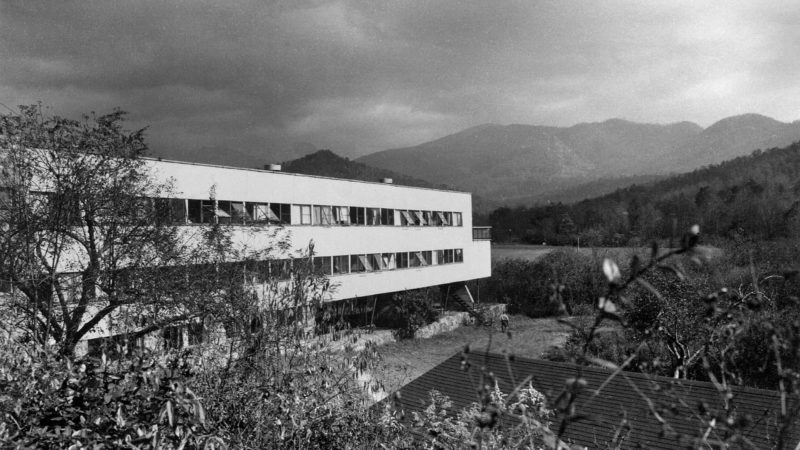 A New Way
The founding of Black Mountain College is rooted in escape from conventional limitations and the pursuit of freedom of thought. John A. Rice was a controversial American educator and Rhodes scholar who challenged conventional teaching practices. He had a rebellious streak that eventually led him to resign from his teaching post at Rollins College in Florida, which was the catalyst for the founding of Black Mountain College in 1933. In searching for the school’s first faculty members, Rice looked toward the Bauhaus in Germany, arguably the most influential modernist school of the twentieth century.
With an aim to abolish the distinction between “fine art” and “craft,” the school sought to unify art with industrial design. The Bauhaus had a democratic mission to synthesize art and technology to create a well-designed environment that could improve society.
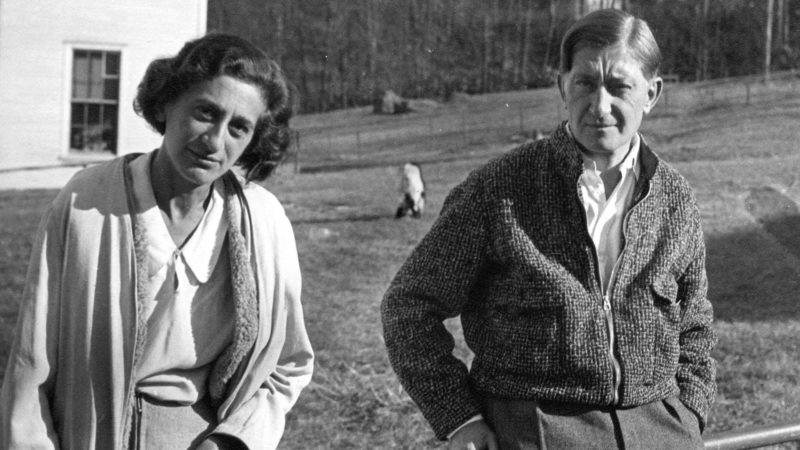
Unfortunately, this mission did not align with the priorities of Hitler and the Nazi Party, and the school was forced to close in 1933. This left faculty and students displaced, and many of them fled to the United States along with other avant-garde artists and intellectuals attempting to escape escalating persecution in the face of authoritarianism. This group included Josef and Anni Albers, who arrived in Black Mountain, North Carolina, in 1933 at Rice’s invitation to lead the art program at his new experimental school.
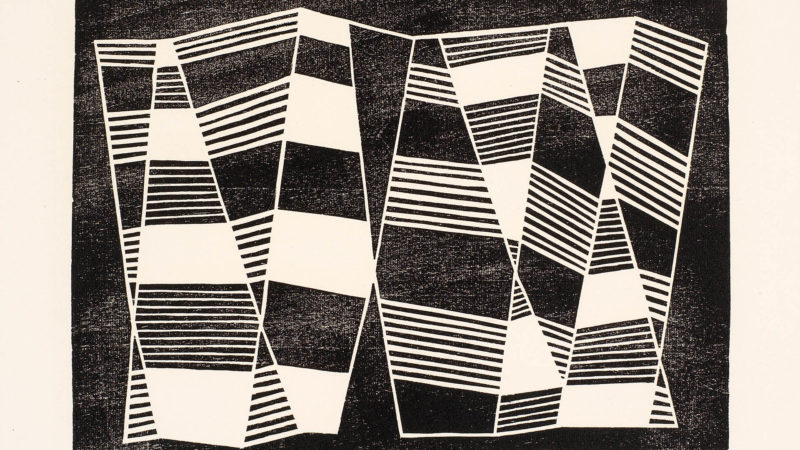
Citizens of the World
Josef and Anni Albers brought the Bauhaus spirit of experimentation in geometric abstraction to Black Mountain College and maintained it until their departure for Yale University in 1949. They also embraced a globalist approach to aesthetics and emphasized the importance of studying art and artifacts of non-Western cultures. Josef’s paintings and prints from his Black Mountain College period are experimental investigations in composition and decorative patterns that seem to combine the vocabulary of abstraction he acquired while at the Bauhaus with an affinity for the aesthetics of Mexico’s indigenous cultures. He is more known, however, for his contributions to Op Art through his Homage to the Square series that he developed in the 1950s and 1960s.
Anni was an assistant professor and ran the weaving workshop with the ultimate goal of elevating textiles to the status of fine art. At the core of her artistic practice and teachings was her admiration for the art and artifacts of ancient pre-Columbian cultures, which she developed after multiple trips to Mexico during the 1930s and 1940s. This look toward the past rather than a rejection of it redefined what it meant to be “modern” and ultimately led Anni to combine the old and the new in a way that changed our notions of what modernism means. Her textiles lift art out of dusty intellectual ideology and unify fine art and craft into a realm that transcends the limiting divide between “artist” and “maker.” Her pictorial wall hangings, especially Ancient Writing (1936) and With Verticals (1946), are excellent examples of her mission to create a new visual language while at Black Mountain College that could be achieved through weaving. Her reimagining of the woven textiles of ancient civilizations created an opportunity to use old modes of representation to revitalize and reinvigorate contemporary aesthetics.
The progress Anni Albers made toward elevating the fiber medium had parallels in the growth of the Upstate textile industry, a connection that seems to be the ultimate realization of the synchronicity of fine art and industrial craft originally imagined at the Bauhaus.
 Artistic Legacy
Although Black Mountain College eventually closed in 1957 due to a void in leadership and a perpetual lack of funding, it had a lasting impact on the development of post–World War II American culture.
Canonical figures of American modernism like Willem and Elaine de Kooning, Robert Motherwell, Robert Rauschenberg, Ruth Asawa, John Cage, Merce Cunningham, and Cy Twombly made many of the most celebrated works of American modern art on the Black Mountain College campus.
Interdisciplinary communal living allowed for the free exchange of ideas that ultimately led to conversations about social justice and environmental sustainability. Ten years before the Brown vs. Board of Education Supreme Court decision, Black Mountain College integrated its student body in 1944, making it the first higher education institution in the Jim Crow South to welcome African Americans. Josef Albers invited Jacob Lawrence to teach at the 1946 summer session, which was a fruitful experience that contributed to Lawrence’s highly successful career as an artist. The first iteration of Buckminster Fuller’s geodesic dome was constructed near Lake Eden during the 1948 summer session with the goal of making housing more economically available for a greater number of people.
Although it collapsed, Fuller went on to perfect his design, which would eventually be reproduced more than 300,000 times around the world and is known to be one of the most innovative, environmentally sustainable, and socially-minded shelter designs ever built.
We can also trace the influence and importance of Black Mountain College on contemporary movements and environments.
The current emphasis on studio practice in the making of both fine art and craft objects embodies an experimental spirit originating from Black Mountain College. Acknowledgment of the blurred line between fine art and craft explains, in part, the emergence of the contemporary “makers movement,” which originated in our region and is now a vital part of the Southern cultural landscape. This unification of fine art and craft tradition as manifested by contemporary makers serves to further democratize art and make it more easily accessible for all to enjoy, which is a core principle of modernism itself.


