

Yoga doesn’t just change your body. It changes your life.
Olivia Daniels Jones was a hard-core athlete, competing in tennis and relishing high-intensity cardio when a friend at Clemson University invited her to yoga class. “I wouldn’t say it was love at first sight,” she says.
But then, a semester-long course on meditation and relaxation immersed her in deep breathing and yoga, and before long, she was feeling energized, sleeping better, and coping with anxiety in a healthier way. “I noticed all the different tools I could apply off the mat,” she says. “Yoga changed my life.”
After graduating and landing a corporate job, she signed up for a yoga class with instructor—and now friend—Marsha Thompson. Jones would walk in feeling overwhelmed and at rock bottom, and walk out “feeling like I’m going to be okay. Yoga taught me to breathe in situations where I feel darkness creeping in; it helps me center and ground myself.”
Yoga results are hard to quantify, Jones says, because only about 20 percent of the effects are visible to the casual observer: improved strength, balance, flexibility. The other 80 percent isn’t physically visible but makes much more of an impact: lessons about self-care, confidence, dealing with adversity, and becoming a better partner and friend.
Those are the lessons Thompson works through in her practice and shares with her growing roster of students. She walked out of her first yoga class “feeling like I took a shower on the inside. I couldn’t figure out why I felt so good.” After pursuing training, she gravitated to the philosophy of it: using your body as a tool to discover more about yourself, breathing through challenges to achieve what was once impossible.
After years of teaching at locations around town, and with hundreds of hours of training under her belt, Thompson decided to expand on her passion. “I wanted to be more involved in the community, and I wanted to create a space that was really inclusive and had a vibe I was missing out on at other places.” She opened Shine Om in August 2022, and in one year has expanded to offer more than 30 classes, from Rise & Shine to Power Vinyasa to Warrior Sculpt.
She’s determined to bring yoga to as many people as she can, showing them how the practice can bring peace and joy to their lives. Starting a business is tough, but she isn’t deterred. If she’s learned anything, it’s persistence—she knows what it’s like to spend months working on achieving a single complex pose.
“It really resonated, that lesson I can take off the mat,” she says. “Whenever I’m met with some impossible situation, and I think I can’t make it through, I can just keep showing up.”
Dynamic Duo
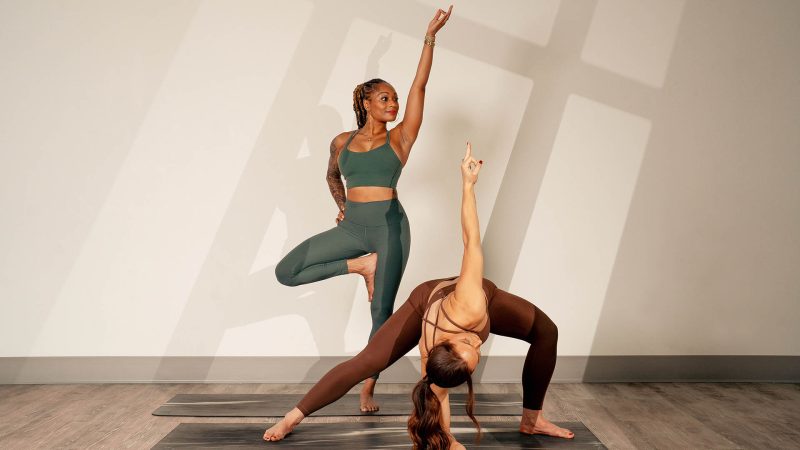
Olivia Daniels Jones
- Instructor at SPENGA (combines spin, strength, and yoga) and master instructor for SPENGA Corporate
- Certified in yoga fit and yoga sculpt
- Teaches classes at Soul Yoga and Shine Om
- Lululemon Ambassador
Marsha Thompson
- Owner of Shine Om
- E-RYT 500-certified (Registered Yoga Teacher with 500 hours of training)
- Former Lululemon Ambassador
- Training in prenatal yoga, sound healing, ashtanga, and more
Find your Flow
 Hatha: Designed to create balance, with strengthening poses and a focus on breath. Poses are held for several breaths.
Vinyasa: This flow-style yoga refers to its focus on flow between poses. A dynamic style, great for learning about breath.
Ashtanga: It means “eight-limb path” in Sanskrit. A series of movements that flow through a set sequence of postures.
Kundalini: With strong, repetitive movements and breath work, this style channels divine feminine energy, with a focus on mental endurance.
Yin: In this slow-paced style, participants hold postures for several minutes. A meditative style that boosts flexibility and mobility.
Power yoga: Arm stands, inversions, and other difficult moves are often part of these classes, which tend to work up a sweat.
Hot yoga: Any yoga style in a heated environment, which tends to allow greater flexibility and range of motion.
Yoga sculpt: classes that blend yoga moves and strengthening exercises; often includes light weights.
A brief history of yoga
Practiced for more than 7,000 years, yoga originated in India. The root word in Sanskrit translates as “unite” or “yoke.” There is some debate about its development, but the first use of the word is in the Rig Veda, a sacred Hindu text, where it was mentioned in reference to breath control and connecting mind and body.


