
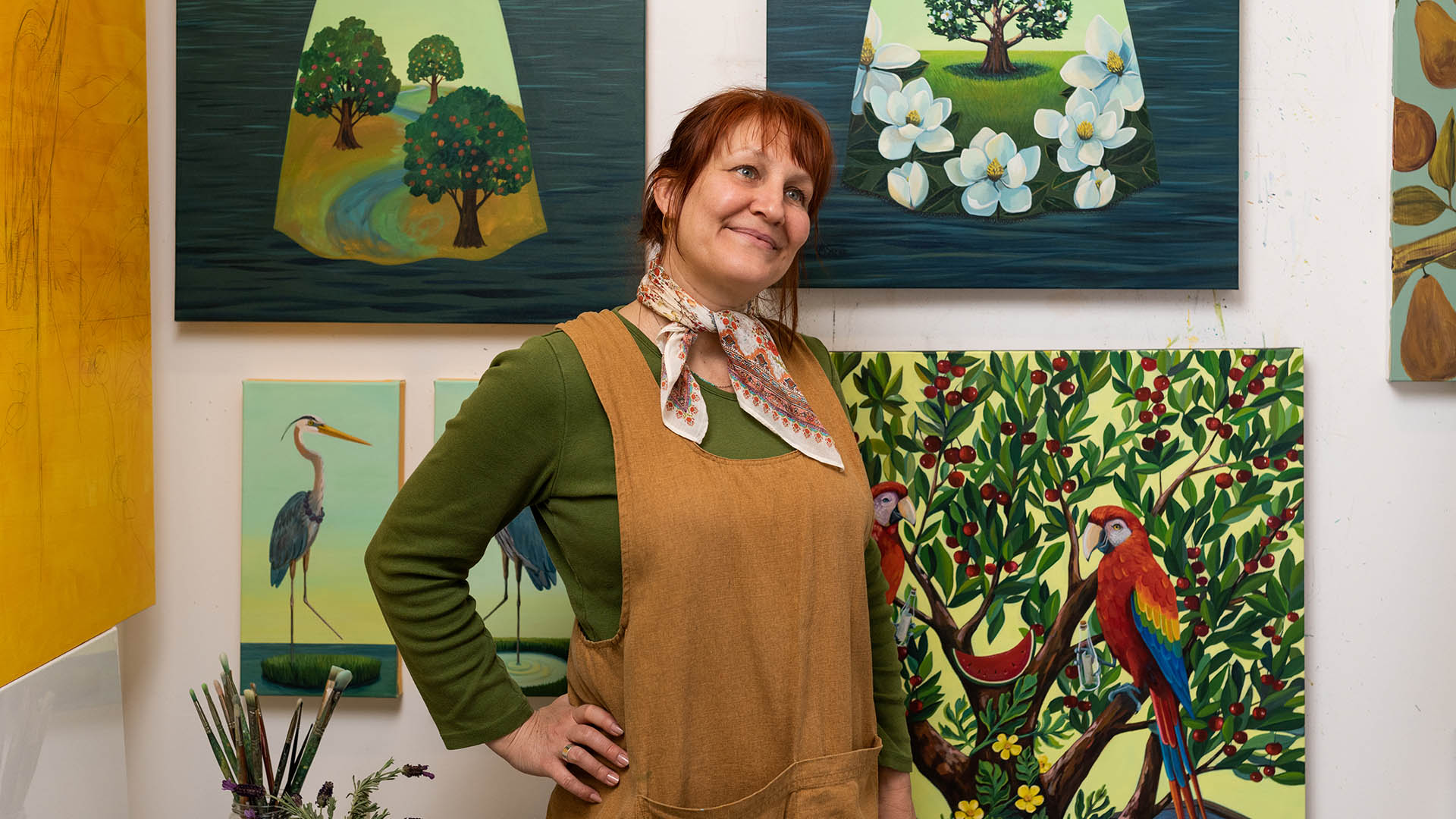
Go deep with surrealist painter and environmental storyteller Lisa Shimko.
“The viewer completes each work of art I make. What you see in it is the meaning you take away,” says Lisa Shimko, motioning to her dream-like paintings, which fill the walls of her sunny studio at Artifacts Greenville. “My work is very stream of consciousness at times. I call it ‘dream logic’—when you first wake up from a dream, [the story] seems to make sense, but when you start trying to be very literal about it, you realize . . . there’s a slight absurdity to everything, a bit like how I think life feels sometimes.”
Vibrant, playful, and full of rich symbolism, Shimko’s surrealistic work focuses on environmental issues, including her feelings and experiences navigating ecological uncertainty. In her Mourning Dresses series, for example, the expanse of water in the background represents the future, and the imagery within the dress represents the past. The artist spent nearly 20 years in the Lowcountry, where flooding was a constant and growing threat. “For me, the imagery represents awareness of what we have and what we stand to lose,” reflects Shimko.
Her Lush Boat series strikes a similar sentiment: that our planet is like a beautiful vessel of flora and fauna full of splendor, one that would be lovely to keep afloat. These newer works, like her previous Dream Rooms series, feature simple, even childlike schemas of wooden boats. “One of the first paintings [in this theme] that I did is called Ballast. A ballast is what keeps things balanced on a boat,” adds Shimko. “That balance speaks to how fragile our ecosystem is, and how easily things can be thrown off. I feel so small in the big picture of what is happening [to our environment], like I don’t have any control over it. My artwork is how I express myself and my frustration so I don’t go crazy, you know?”
Fans and collectors of Shimko’s work are drawn to her captivating colors and small but significant details. Even in her tiniest paintings, well-known songbirds are adorned with delicate crowns. “They’re common backyard birds, but there’s beauty in them, and they play such an important role in our ecosystem. In our busy day-to-day lives, I think we often overlook the obvious of what’s all around us in nature.”


