
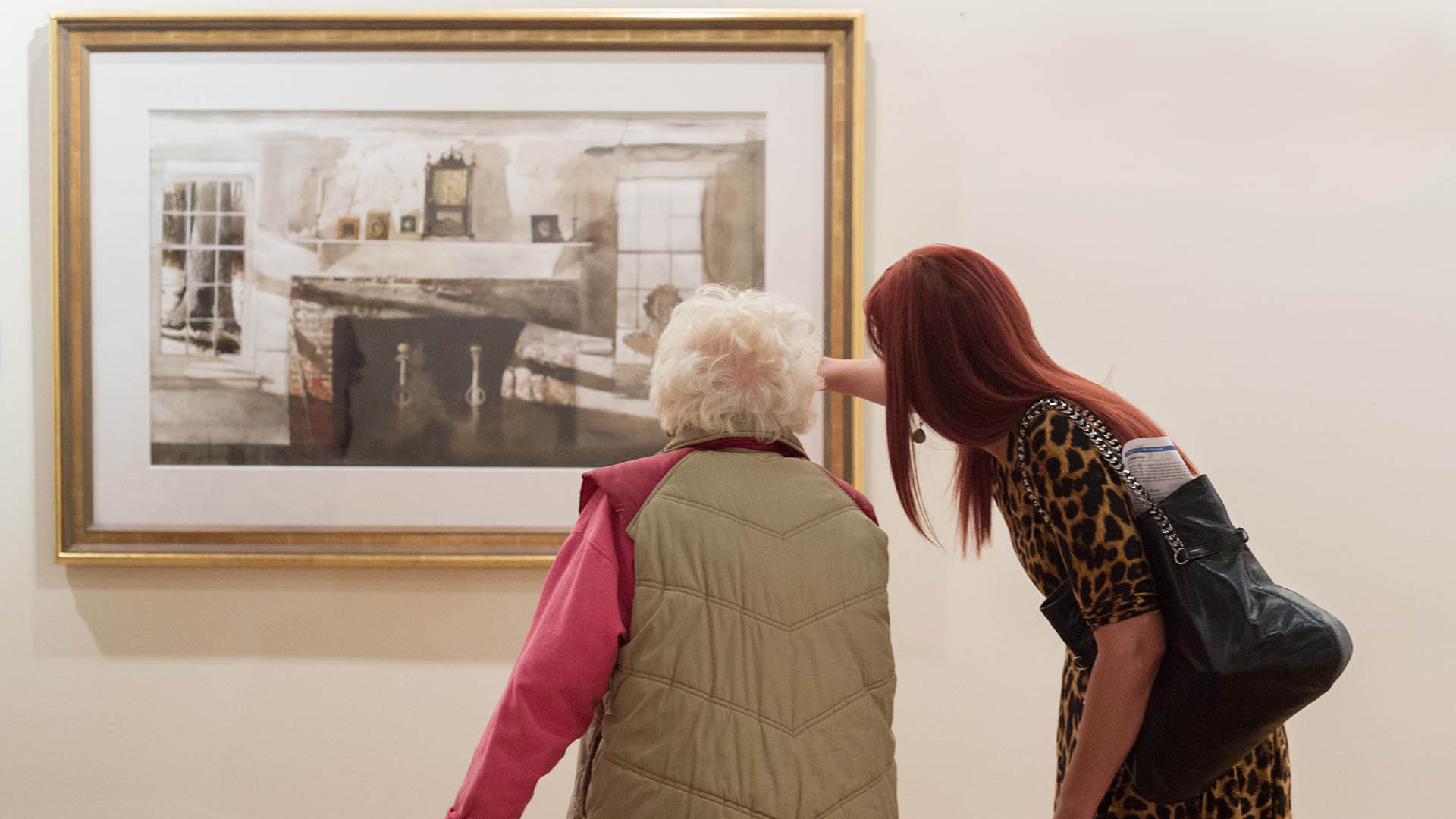
Andrew Wyeth’s work leads an impressive collection at the Greenville County Museum of Art
“The Wyeth family has an extensive group of artists, don’t they?” I ask Paula Angermeier, head of communications at the Greenville County Museum of Art (GCMA). As we’re ascending the stairs to the main gallery at the museum, she confirms, “They’re kind of a dynasty, honestly.”
I had the pleasure of touring the museum galleries with Angermeier to learn the story behind our world-famous collection of works by Andrew Wyeth, the youngest child of famous illustrator N.C. Wyeth and the father of renowned contemporary artist Jamie Wyeth. Andrew Wyeth’s muted tones, realistic compositions, and familiar subjects reflect a shared artistic vision that runs through generations of the Wyeth family, revealing a deep connection to the land and its people.
“Part of what makes the Wyeth family so interesting is they didn’t really go to a lot of places to study or to paint,” Angermeier notes. “They just painted what they knew—the surroundings of their family home in Pennsylvania and the coast of Maine, where they spent their summers.” As we walk alongside Andrew’s work, we stop at a painting of an apple—simple, yet probably full of hidden meaning. His familiar angles and seemingly simple subjects evoke a feeling Paula describes as “comfortable loneliness.” It’s the perfect way to put it.
Unlike the bold experimentation of Abstract Expressionism and Modernism in his time, Andrew’s more realistic style wasn’t always well-received by critics. “He didn’t appear to be pushing the envelope the way other artists getting attention were,” Angermeier explains. But his value has stood the test of time, with a 2023 auction sale hitting $23.3 million. That’s what is so fascinating about the economics of art—one moment a piece might be considered by the market to be worthless, and the next, it’s breaking records.
The GCMA isn’t looking to capitalize on this rise in value, though. Instead, they continue expanding the world’s largest public collection of Wyeth watercolors. “We now have 65 finished watercolors, some temperas, and a rare self-portrait as well as sketches and studies,” Angermeier says, proud of what this collection means for Greenville. The museum goal isn’t quantity, but a well-rounded representation of Wyeth’s long and prolific career.
Greenville County Museum of Art Collections
The museum’s relationship with Wyeth dates back over 50 years. A pivotal loan of his work in the 1960s helped shape its identity, and in 1974, local businessman Arthur Magill secured the purchase of a collection from a Hollywood producer, placing it on permanent loan to the GCMA. That collection’s sale in 1989 left a void, but the museum has since expanded its collection of Wyeths, which brings visitors from around the world.
Wyeth’s work has a unique place in the GCMA collection, amid an impressive selection of American art including work by Jasper Johns and William Henry Johnson. The museum also has a significant focus on Southern art and subjects, holding the world’s largest institutional collection of pottery by enslaved South Carolina artisan David Drake, part of an important and growing collection of African American art.
Whether you’re drawn to Wyeth’s quiet introspection, the bold strokes of contemporary art, or the storytelling of the South, the GCMA offers a collection that continues to evolve while staying true to its mission. Exhibitions rotate regularly, and every Sunday at 2p.m., the museum hosts a free event, inviting the community to engage with art in meaningful ways. Learn more at gcma.org.
Sterling Crawford is an artist and founder of Stall Three Studio, an online gallery known for showcasing international artists in the Greenville area, fostering cultural exchange, and connecting collectors with a wide range of international artists. Visit stallthreestudio.com to stay updated on their upcoming Spring 2025 exhibition, which highlights South African artists and culture.


