
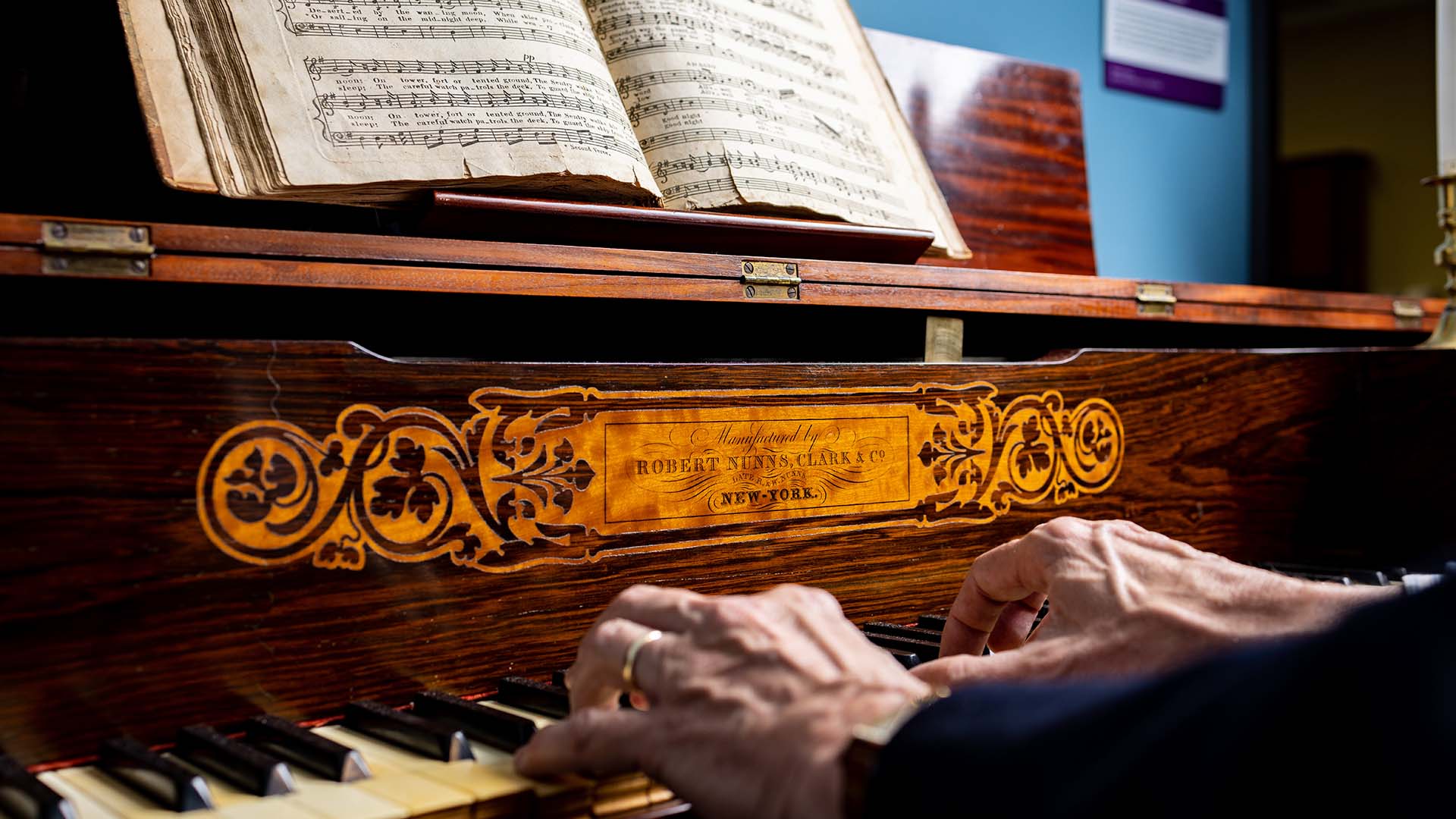
Thomas Strange of Sigal Music Museum helps people see, hear, and feel the music of the past
A harpsichord owned by Queen Charlotte and a 1943 Martin guitar that belonged to Greenville’s own Josh White—these are just two of the remarkable instruments in the Sigal Music Museum, where international and local history are in concert.
The idea for the museum originated with the personal cache of chief curator and artistic director Thomas Strange, and the collection has grown to include 154 pianos, harpsichords, and clavichords. It also contains 600 woodwinds, 30 instruments in the guitar family, and 250 ethnographic or folk-type instruments, along with a library of vintage sheet music and vinyl.

With a background in physics and medical devices, Strange’s career included working to reduce the size of defibrillators. When his company was purchased in 2017, he “turned the clock back 200 years,” focusing on a different type of technology. He actually built a harpsichord in 1980 and modestly says he “schlepped it” to various functions, including performances of Handel’s The Messiah at the Peace Center. An instrument Strange built is still occasionally featured in Peace Center performances.
Over the years, Strange acquired and learned to restore many antique instruments. One day, a friend asked a crucial question: “What happens to all of this when you’re gone?” Supported by community activists Steve Bichel and Beth Lee, along with his wife, Debra, Strange was determined to share his treasures, and the Carolina Music Museum opened at Heritage Green in 2018.

Strange’s collection was already significant when something happened that redefined the museum: internationally known collector Marlowe Sigal passed away. He and Strange became acquainted when Sigal had worked on a book about his own massive collection. Sigal played saxophone at Harvard, marching in at least one game a year for sixty-six years. He performed up until the time of his death but had made no provisions for the instruments that would form a key portion of his legacy.

“The big museums wanted to cherry-pick, but ideally the collection would be kept together,” Strange says, noting that sixteen twenty-six-foot trucks—the largest that Sigal’s Newton, Massachusetts, neighborhood of nineteenth-century mansions could accommodate—transported the collection to Greenville after he came to an agreement with the Sigal family.
“We want this to be an immersive experience,” Strange says. “People can see, hear, and feel the music.”

Sigal Music Museum
Heritage Green Campus, 516 Buncombe St, Greenville
864-520-8807, sigalmusicmuseum.org
Current exhibit: Sounds of America, through March 2023
Open Tuesday-Saturday 10 a.m.-5 p.m., Sunday 1 p.m.-5 p.m.
Concerts on Thursday and Friday nights


