
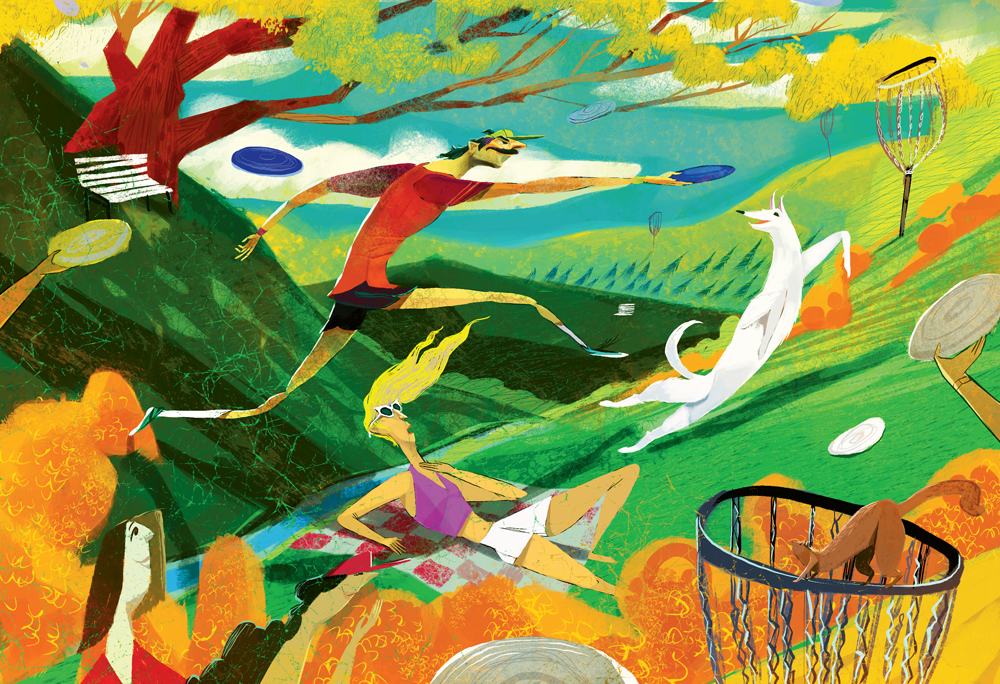
The first time I gripped, and attempted to rip, one of the colorful discs that are the hallmark of this sport, I nearly whacked a family of five. Lesson learned: just like in traditional golf, a cautionary shout of “fore!” and time spent practicing your drive are fundamental to having fun and avoiding concussions.
Along with a healthy dose of swearing at oneself, disc golf really does reward hours of challenging play with personal growth and companionship on the course. Some sports, with their rigid, technical rules and time-honored traditions, feel very much like just that—a sport. With its youthful enthusiasm, active experimentation, and approachable cost of entry, disc golf often falls beautifully into the basket of a game more than anything else.
And not surprisingly, the game itself is played much like golf; only, rather than a ball and clubs, players use a flying disc. Formalized in the 1970s, the sport shares with traditional golf the object of completing each hole in the fewest strokes (or, in the case of disc golf, fewest throws). This is generally accomplished with three kinds of discs: putters, mid-range, and drivers, which come in a wide variety of colors, weights and materials. With more than 7,000 disc golf courses in the United States and 10,000 worldwide—most of which are free to play—chances are good that there’s always a course nearby.
love for the sport, and the friendships it fosters, continues to spread across the globe.
The sport’s recent explosion in popularity wouldn’t have fazed the “Father of Disc Golf,” Ed Headrick, who was passionate in his belief that the game held enormous potential appeal. A prolific inventor nicknamed “Steady Ed,” he held dozens of patents, including two paramount to the sport: the original Frisbee in 1966 as an employee at Wham-O, and the basis of all disc golf targets today; and the Disc Golf Pole Hole in 1975. Headrick went on to design and install the first courses (many of which are still played today), helm the first official Championship tournament, and ultimately founded the PDGA (Professional Disc Golf Association).
As more and more new players step onto these courses—often more wooded, rambling parks than open and manicured green spaces—love for the sport, and the friendships it fosters, continues to spread across the globe. Sure, some of that interest stems from viral YouTube videos, like a recent mind-blowing, 247-foot birdie thrown at the Disc Golf Pro Tour by James Conrad, or the incredible albatross thrown by Philo Brathwaite in 2016, which has now been seen by tens of millions of people and even covered on Comedy Central.
Every round is a win if you’re in good company, the weather cooperates, and you’re there to have fun.
But the majority of the interest comes from families, kids, and new players of all fitness levels drawn to a healthy, inexpensive outdoor activity that transforms a beginner’s concentration and commitment into new skills, new strengths and a lifelong love for the game.
For players like me, only just cutting their teeth on a set of colorful putters, I’ve got a long way to go before I’m on par with my peers (and not just fishing discs out of creek beds). The good news? Every round is a win if you’re in good company, the weather cooperates, and you’re there to have fun. Just take it from me: until your aim is true, avoid playing too close to the playground.
10 UPSTATE COURSES as Ranked by UDisc App
- Hampton Park DGC
- Timmons Park
- Dolly Cooper Park
- Century Park in Greer
- Dacusville DGC in Easley
- The Gospel Discovery in Simpsonville
- Foothills DGC in Easley
- Holmes Park
- Gower Park
- Furman University
A WORLD CHAMP LIVES HERE
Maybe you’ll run into Ricky Wysocki on the course, the #2 World Champion, based out of Fort Mill, South Carolina. The Ricky Wysocki Grenade Putter, a line of discs manufactured by Innova Discs in North Carolina, is named after him.
Illustration by Timothy Banks.
disc golf greenville sc disc golf greenville sc


