
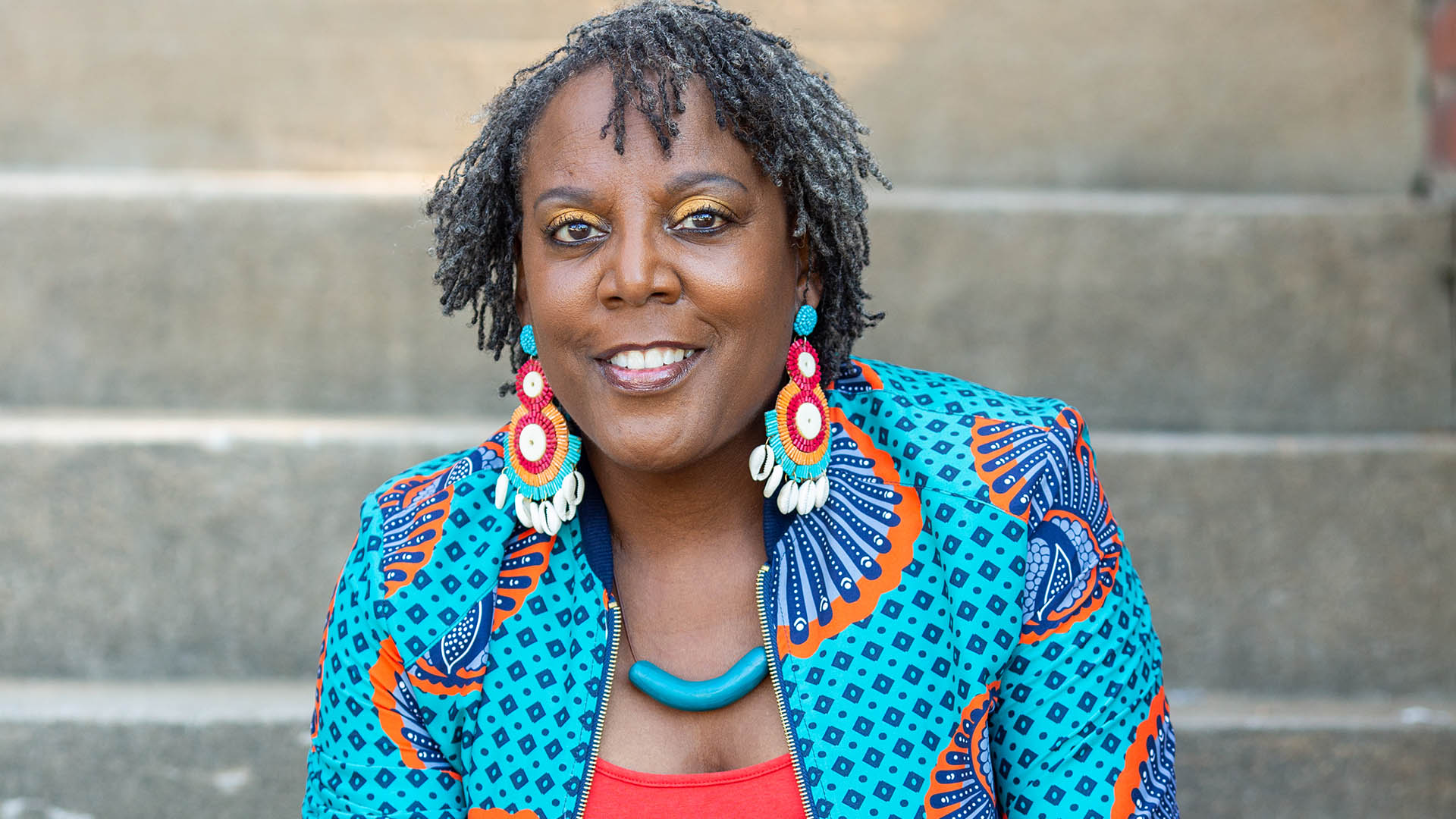
Glenis Redmond, Greenville’s first poet laureate, on the illuminating power of poetry
Among her many facets, Glenis Redmond is a poet, archivist, and historian who transforms personal, regional, and genealogical truths into verse. Significantly, her poetic journey began when she was 10 years old and attending a Black History program in 1973, three years before Black History Month was established as February in 1976. Fifty years after her poetic awakening, Redmond is a renowned poet illuminating her own history.
From personal to historical, including her Upstate experiences and Afro-Carolinian roots, Redmond’s truths can be difficult, but that’s part of her beauty. Where there’s sorrow, there’s joy; in struggle is triumph, and in pain, there’s healing. By channeling, joining, and conversing with ancestral and luminary voices, Redmond strengthens her own. Another part to her beauty: as a poet and educator, she encourages this process for all.
Along with her many awards, positions, and accomplishments—including the Governor’s Award for the Arts, 17 years as a Kennedy Center Teaching Artist, and six published books—Redmond is now her hometown’s first poet laureate and will continue her work locally and nationally. In her words and verse, here’s more about her background, new role, and poetry.
Q & A with Glenis Redmond
How does it feel to be your hometown’s first poet laureate?
It feels wonderful, like one of life’s full-circle moments. I began writing poetry at Woodmont Junior Senior High School in Ms. Sergeant’s English class in the eighth grade. Writing in my journal in that class paved the way for me emotionally and, eventually, professionally. Yet, I believe I was born both a poet and storyteller. As I look back over my life, there were signs before I even began writing in my journal. At Carter Lake Elementary School on McChord AFB, my fourth-grade teacher Mrs. Priest, wrote on my report card, “Glenis’ oral work is very good; enjoys talking, acting, singing before the other children. I hope she develops this talent.” After 28 years as a poet and teaching artist, I believe that I have made good on Mrs. Priest’s hope for me.
Your poetic journey began when you heard a poem at a Black History program in 1973. Will you tell us about this encounter?
Yes, it was a transformational moment. I heard this poem in the fifth grade in Aviano, Italy. I was sitting in the back row of the gymnasium. When Yolanda Walker, a 10th grader, recited it at a Black History program, I sat up and took notice. I felt that the poem spoke directly to me. “1,968 Winters” by Jackie Earley was the first poem/literature that reflected me and my experience. The poem empowered me, gave me a sense of agency, and I am sure that moment solidified my journey as a poet. At the time, I did not tell anybody about how the poem moved me, but I carried the poem and that moment with me. It was a sociopolitical poem laced with humor and colloquial speech, and it had caught hold.
How are you carrying forth your initiation, exactly 50 years later? How has your poetry stayed the same, and how has it evolved?
My work has unfurled organically. I am still writing, teaching, and performing poetry half a century later. I turned not only into a poet, but a teaching artist and a literary citizen. I did not keep poetry to myself. I started on an earnest path to give poetry away to others. As a poet, I make deep meaning from the day on which I was born, August 27, 1963. The day before Dr. Martin Luther King, Jr. gave his “I Have a Dream Speech.” Also on this day, W.E.B. Dubois passed. This is the context in which I was born. Dubois wrote, “Education must not simply teach work, but it must teach life.” Poetry is my practice, my profession, and my passion. It continues to ripple in my life from the divine, to myself, to others, and out to the world.
Your poetry confronts your personal history of illness and painful historical truths, including those experienced by your family in the region. What is the role of poetry in the context of these histories?
For me, poetry is my greatest archeological tool, and it allows me to examine both personal and collective pain, trauma, and illness. Though I come from a resilient people, that does not negate our struggle. It is my job to examine it all from the past to the present. Poetry is also the way I time travel. As a child, I was always interested in my parents’ and my grandparents’ stories about the way life was for them when they were growing up. My parents, Johnny and Jeanette Redmond, were born in 1936 in the middle of the Jim Crow era. As a poet, I am also a cartographer tracing my lineage as far back as I can go. My ancestors beyond my grandparents were proud, intelligent, but mostly illiterate field hands. I write for them. They write through me. It is not always an easy journey, but their stories are a vital part of the American fabric.
You have a background in counseling. In what ways do you bring this experience to your poetry and work as a teaching artist?
I do my best as a facilitator to listen deeply to provide space for participants to delve deeply. We usually sit in a circle at my workshops. I ask key questions of my participants, so that they may go on their own personal quests. They return with nuggets of reflection. Then, they write it out. Though my poetry workshops are not therapy, I believe they are therapeutic. Writing can be cathartic. I am still a counselor at heart. In my workshop, there are tears and plenty of laughter.
Will you tell us about your work as a teaching artist and educator? What do you hope to accomplish through your workshops?
I try not to focus on the outcome, but the process. I want my students to explore and enjoy the process of creativity. I want them to build a sense of agency as they write. Julia Cameron’s The Artist’s Way taught me to value process. For me it is a spiritual journey. I am not trying to make people poets, but to help them be open to the poetry in their lives. Yet, I have opened the door for many people to become poets. I get calls and emails from past students. They tell me when they get an MFA in poetry, when they begin teaching poetry on the graduate level or the high school level. They reach out when they have published their first poetry books. Or, just to let me know that they are still writing poetry, they have won an award when they have just received their master’s degree in engineering or another area yet are running poetry circles with their peers. I am pleased that my students stay in touch with me. The circle continues.
How does your appointment as Greenville’s first poet laureate reflect progress in the city?
I began Greenville’s first poetry slam in the 1990s on Main Street. I thought this to be ironic, as my father was a busboy at the Poinsett Hotel in the 1950s on Main Street. He joined the Air Force because of the racial strife that he endured in that position. My parents’ migration shaped and molded me. Then, I returned to Greenville almost 11 years ago, and I was the poet-in-residence at the Peace Center off Main Street, only a few buildings down from where my dad was a busboy, and called out his name often. My mother still talks to me about the Greenville of the past. I write from her memory often. Greenville is not the same city from 60, 50, or 40 years ago. I love seeing the progress in Greenville on many fronts. I love our city. There is a reason why people keep moving to our beautiful city. I am looking forward to seeing Greenville grow even more. Being diagnosed with stage 3 multiple myeloma in 2019 and going through a stem cell transplant in 2020 has taught me to be thankful and grateful. It has also fueled my search for meaning, beauty, and grace. I am truly honored to be the city’s first poet laureate on so many levels.
You just published The Listening Skin. What’s next?
My next book will be published in January. Praise Songs for Dave the Potter, Art by Jonathan Green, and Poetry by Glenis Redmond (University of Georgia Press). Also, I have just finished writing my seventh book. It is called Raised by Hand: A Poet’s Memoir-in-Essays. I am also working on two YA novels-in-verse.
What do you hope to accomplish in your new honorary role, and do you have upcoming events on the calendar?
My first official reading as a poet laureate was for the alumni of Washington Schools. They are raising funds to create a memorial for their historical Black elementary and high schools. I wrote a poem for the occasion titled “A History to be Remembered.” I was honored to be asked to recite my work for the kick-off fundraiser.
I still work nationally, but I prize working in Greenville in our community. There are numerous engagements on the books, including Goodwill Industries of the Upstate and Midlands, senior citizen centers, The Upstate Circle of Friends, the Governor’s School, and several engagements for the City of Greenville. I am only in my third month of my laureateship. I will be partnering with the Peace Center, The City of Greenville, the Metropolitan Arts Council, and other organizations to continue my outreach. I will be collaborating with many of our fine poets in Greenville. One of my first projects is to install Greenville’s first youth poet laureate. We started taking submissions for that post on January 1, 2023.
Applications for Greenville’s first Youth Poet Laureate are open! ✍️ This honorary position will mentor under Poet Laureate Glenis Redmond and will serve for 2 years to promote literature among city residents.
Applications close March 10.
➡️ Apply at https://t.co/A2znQxykkR pic.twitter.com/tKsp51EMhN
— Greenville Events & Cultural Arts (@gvilleevents) February 10, 2023
Provided Poem
Instructions on How to Write a Praise Poem
Find the good and praise it.–Alex Haley
By Glenis Redmond
Write Praise. Not Hallmark like. Not puffed up either. Not top down with you at the apex. Not your voice caught on a continuous loop of I. I. I. Not a boast. Not self-centered but from the center of yourself. Sing your song of discovery. Index your joy. Then, rise. Think eagle’s eye view. A poetic review. Then, come back to the page. Weave a story. Stories. Not linear. A circle. Patch the pieces. Start from the day you were born or before. Or, somewhere in the middle. Tell us about your mother or your father. Write of an aunt or an uncle, anyone who saw you wholly. Or an ancestor long gone, who meets you in the dreaming.
My great grandfather, Will Rogers, from Waterloo, called to me from cotton fields. He handed me his feeble X. It became hot silver in my hand. He told me to spill the whole alphabet for him. He said, “sow.” I heard sew. So, I clutched memories and words from both soil and stars and began making a quilt. Odd, when my poetry come together, they liken to crops standing row upon row. Landscape quilts. Read between the lines. There’s plenty of shadows and ghosts too. They’re not to be ignored, but that’s an exercise for another day. Do not get stuck in the weeds. When you attempt to praise, sorrow and rage will always bubble up. They want to have their say too. Don’t let the fishbone catch in your throat. Don’t let the cat have your tongue. Shake out the cramps from your fingers. Write it as whole as you can. Weave a constellation of light. Connect the dots.
I am made from swaths of red clay from the Carolinas to the West Coast of Africa. Stirred and streaked by whispers, well water, sweat and dreams. In my words, I stand tall because in my I AM there’s always a WE, a choir singing. They urge me to make poetry at every turn to raise my voice. They instruct me to praise myself. Praise them. Praise the Divine. Praise every living thing. Tell me: to make a splendid faire with flair.
I pass the praise pen to you. Who held you to the light? I bid you to do the same with them. Who do you mourn? Whose memory do you want to keep alive? Bring them forth. You know the ones with the kind words and the even kinder eyes. The ones who stood beside you and bettered your days. In other words, who made you flourish? Connect the dots in the constellation of your own lineage. Time travel on purpose.
Today your assignment is Praise. Think tendon. See bone, muscle, and connections. The more you practice, the stronger your eyes become trained at spying beauty and meaning, even in the struggle. Know you have never been a singular flame. Look up. Look out. Look around. Take note of every bright thing that brings you alive. Morph. Transform into this poem. This is your own metaphorical reckoning. Then, pen it to the page. Drink deep from your poetry pot liquor. The old folks know this as medicine. Down your Affirmational creation made by your own hand. Stories. Then, wrap your glowing historical strands about you. Call it what it is. Gratitude. Grace. Wear it well. This is your assignment—not for a grade, but for Life.
Photography by Amber McDowell


