
Rick Huffman created a movement to preserve South Carolina’s native flora.
It doesn’t matter where you live in the Upstate—every day, lawn mowers and leaf blowers erupt like swarms of cicadas, breaking the summer silence. By mid-July, sprinklers frantically pivot across gardens in a vain effort to keep colorful annuals alive. Rick Huffman simply shakes his head with a smile. “I’m keenly aware of how maintenance-intensive it is to sustain landscapes with grass and plants that aren’t indigenous to our area,” he explains. “It’s energy-intensive, it’s labor-intensive, it’s expensive. It’s why I became an environmentalist.”
To say he’s an environmentalist short-changes his resume a bit; kind of like calling Tom Brady a Pop Warner player. Huffman is the founder of the South Carolina Native Plant Society, principal of Earth Design Landscape Architecture & Environmental Design, environmental advocate, author and professor, and recipient of the Governor’s Award for Environmental Awareness. In short, the 69-year-old has committed his career to preserving the earth as we know it.

“I’m a broken record,” he admits. “I want to make a difference in the environment. We all want the same things: clean air, clean water, and quality of life. And we should want to pass that on to our children and grandchildren. My mission is to educate and advocate for the precious things around us we call nature. To speak for that which can’t speak for itself.”
That passion sprouted after graduating from Parker High, while working for a nursery and then Furman University landscaping. “I realized I was working with living things,” he shares. “I loved learning the Latin names and the science behind plants: what makes them work, what keeps them alive.” He discovered that native plants were nowhere to be found in the ornamental beds he was cultivating, nor in the shops he relied upon for flowers to fill those beds. Huffman tilled the soil for change.
Father Earth

He wrangled a spot in the University of Georgia’s School of Environmental Design and Landscape Architecture, where his passion for sustainability through native plants bloomed like a magnolia on Mother’s Day. He tried a couple of jobs within the industry after graduation, only to beat his head against a horticultural wall. “I was told, ‘You’re talking one language, and we’re talking another,’” he recalls of employers who weren’t environmentally minded. So, in 1996, he created a platform to educate with the S.C. Native Plant Society, and a business to implement evolution with Earth Design. “I was without a market and without clients who appreciated our local flora and fauna,” he says. “I was tapping into something that hadn’t been done before. I quickly discovered there was pent-up demand. I was in the right place, at the right time, with the right bandwidth.”
Within two years, the SCNPS blossomed with chapters across the state, and Huffman found himself guiding the Forest Service and Department of Natural Resources on plant communities. Business also grew, and now, more than twenty-five years later, Earth Design has assisted thousands of clients with landscaping needs that honor the environment, even restoring damaged habitats. “The restoration of Furman Lake was one of my favorite public projects,” Huffman reveals. “The Pickens County Museum is another. We were able to use all indigenous plants and showcase the various communities of Pickens County. Did you know Pickens County is one of the most biodiverse counties in the world? It has 1,400 species of plants, and we’re still finding new ones. The Valdivian Rainforest in South America only has 575.”

Friends of the Reedy River, the Conservation Coalition of South Carolina, and the South Carolina Botanical Gardens on the Clemson University campus are just a few of the many entities that have benefited from Huffman’s expertise. He continues to use every avenue he can to advocate for the earth through responsible landscaping and is currently working on a book diving into the “slow growth” of environmentalism that started in the ’70s. “Look at the Reedy River compared to what it once was,” he points out. “That’s because of education and advocacy. That’s been my mission and continues to be my mission. I may retire from different things, but not from being an advocate and bringing people together to make a difference today. Native plants are the base of sustainability in landscaping. I want to be a good steward.”

Sustainable Summer Growing Tips
Select native plants that are drought resistant.
Create a diverse environment with different species of plants.
Plant flowers that will bloom at different times and be a nectar source for pollinators.

Native Plants . . .
. . . will survive normal weather extremes for the Upstate.
. . . use less water (a 1,000-square-foot lawn requires 10,000 gallons of water per summer to stay green).
. . . provide ten to fifteen times more food and shelter for native wildlife.
. . . improve air quality, as they don’t require motorized equipment for care (leaf blowers emit ten to thirty-four times more hydrocarbon than a car). Non-Native Plant Alternatives
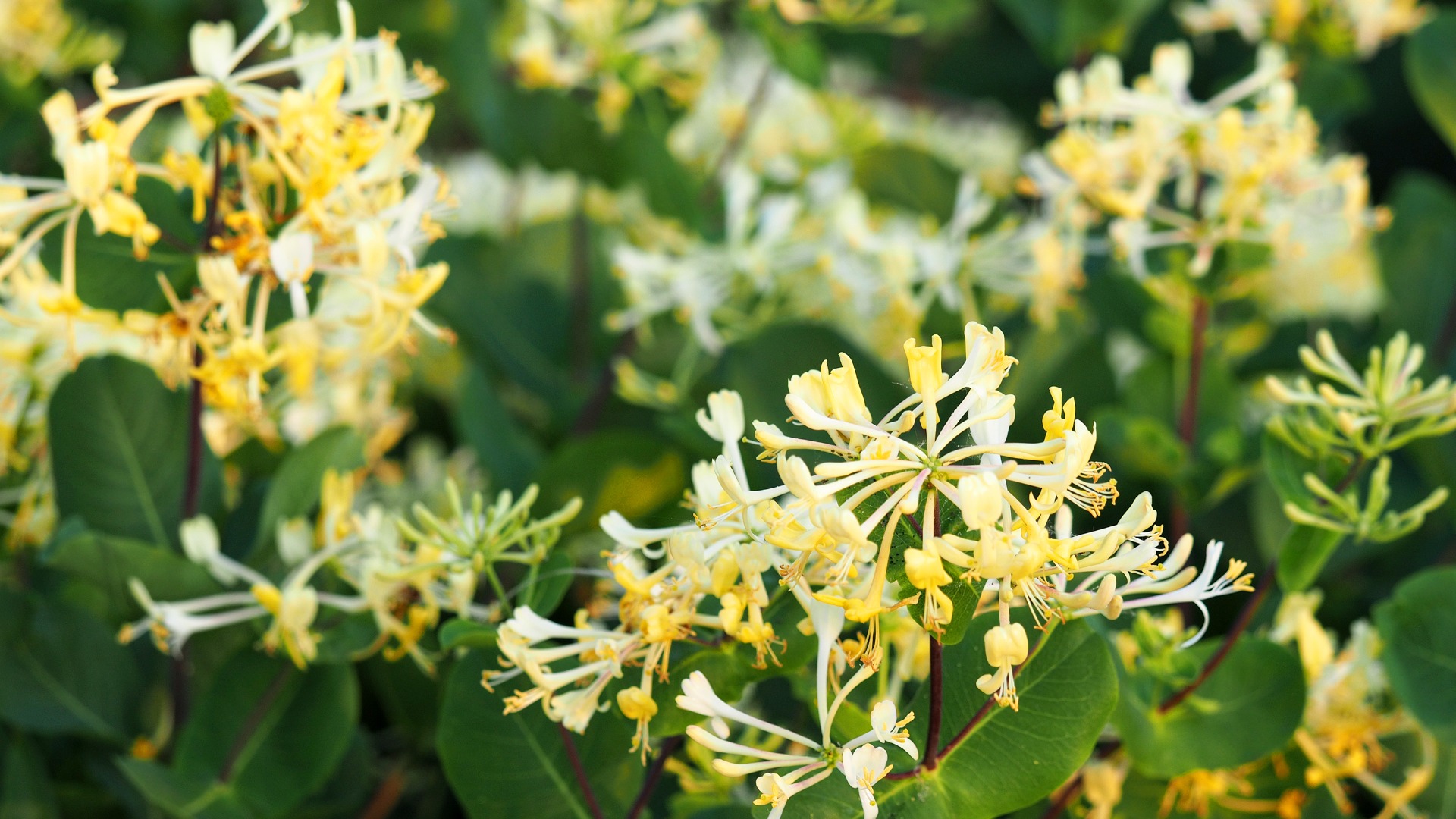
Invasive: Japanese honeysuckle / Alternative: Carolina jessamine
Invasive: English ivy / Alternative: trumpet creeper or wild phlox
Invasive: Bradford pear / Alternative: redbud or Southern sugar maple
Visit SCNPS.org to learn about native and invasive plants, as well as what to plant in sunny and shady areas. For more on Rick Huffman, visit EarthDesignSC.com.


