
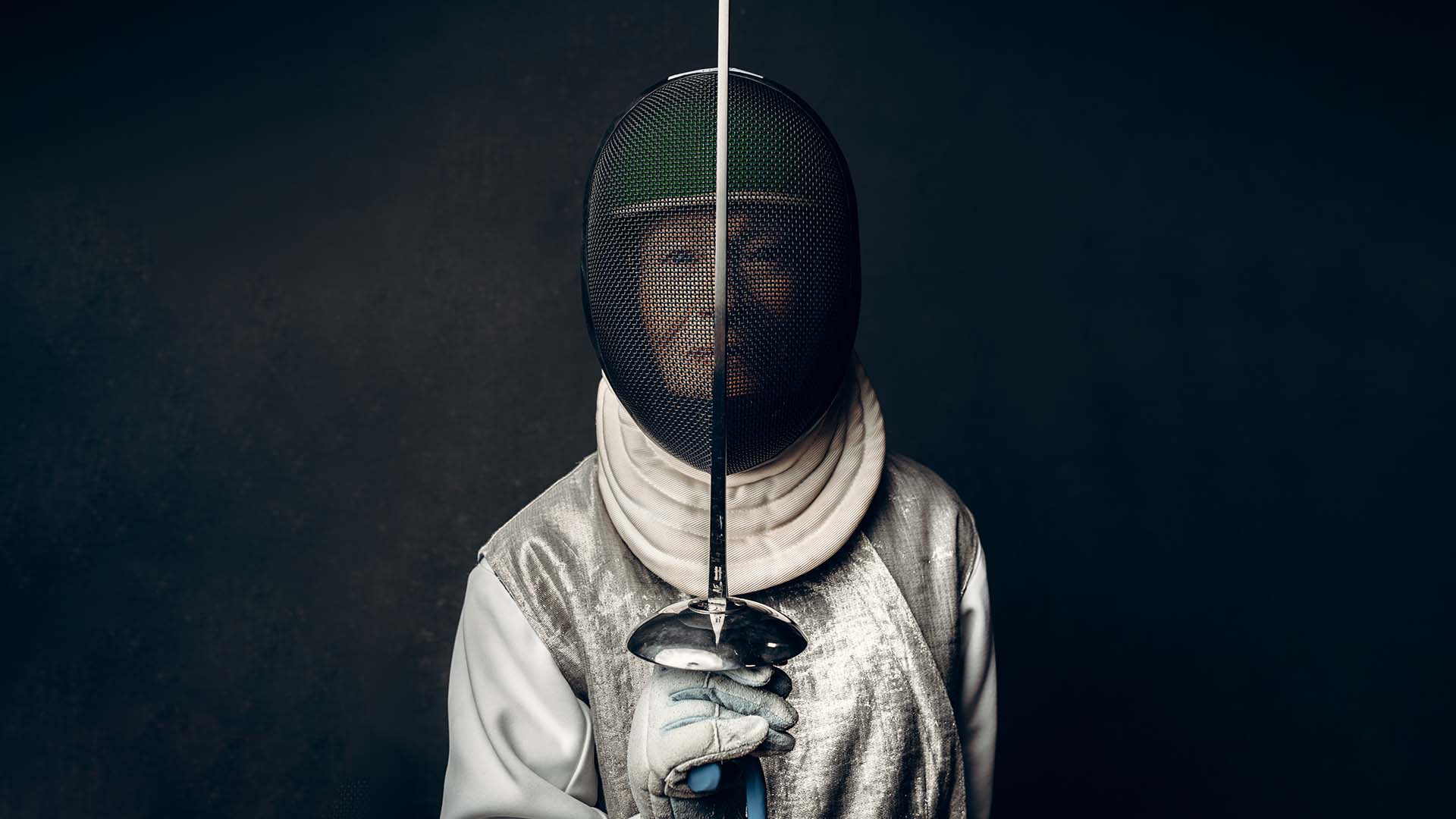
The art of swordplay may bring to mind the Three Musketeers. Or perhaps the swashbuckling character in The Princess Bride who took up fencing when he was 11 and made famous the line: “My name is Inigo Montoya. You killed my father. Prepare to die.”
“As far as any blood and broken bones, you’re not going to have any of that with this, but you still get to go up against someone else,” says Hal Roach, who began to fence in 2017 after practicing Japanese martial arts for years — that came along with cracked ribs and a busted collarbone.
These days, the 61-year-old Greenville attorney is among a handful of over-55 combatants in Greenville’s robust community of fencers 12 and older. The age range, Roach and others say, adds that much more appeal.
“Fourteen-year-old girls can cut you to ribbons,” he says with a sly laugh.
Roach typically faces opponents at least half his age if not younger, he says. And he notes that few sports offer opportunities for multigenerational athletes to compete against and coach one another.

“When I go up against them, I try to make them better so that they’re better than I am. They’re able to go up against you, try out their techniques and see if they work or if they don’t work,” he says. “Sixteen-year-olds are going to teach me as much as I teach them—probably more.”
He likewise relishes the benefits he sees beyond the bouts: “A 13-year-old, you could see his development, you could see him maturing. Becoming a more responsible kid.”
Joan Vande Velde credits the sport with helping her land her first job teaching high school after graduating from the University of Illinois, where she took fencing as an elective. A school in the Chicago suburbs wanted to expand its gym program, including fencing. She got hired.

Of her 32 years teaching phys. ed., she taught fencing for 25: “There were always a few people in the class that really got the strategy of it, the chess-like maneuvers.”
She learned just how little she knew about the sport when she accompanied her then-husband, John, to the Olympic Games in 1968 in Mexico City and the 1972 Games in Munich. He was a world-class velodrome cyclist. She wandered off to watch the elite fencing competition.
“I couldn’t tell you one thing that was going on,” she recalls. “It was just so lightning fast.”
She moved to Greenville three years ago to be closer to her family. (Her son, Christian, a former pro cyclist and Tour de France veteran, lives a few blocks away).
Shortly after her arrival, she took a fencing course at Osher Lifelong Learning Institute at Furman.
She hasn’t fenced since, but she sounds as if she will pick up the foil again. “I’m really drawn to movement of any sort,” she says. “I like to dance. I’m still a tap dancer.”
Liz Warrick tells a similar story.
One Saturday morning in September, she sat in the C1 Sportsplex in Mauldin, where a tournament was underway with 80-plus combatants from throughout the Southeast.
Warrick, 77, came just to watch. In spring of 2021, she and her husband, Wick, moved to Greenville from Santa Fe, New Mexico. A few months later, after a hiatus of more than 30 years, she started taking lessons from Foothills Fencing Academy, which sponsored the tourney.
Last Thanksgiving, she injured her left shoulder playing flag football. But she also plays tennis, so she figured that fencing was a fine way to keep in shape.
“It’s an elegant sport, really,” she says. “It is a ballet in a way.”

Greenville’s longest-running and largest fencing schools
Foothills Fencing Academy
1004 Piedmont Hwy
Piedmont, SC
foothillsfencingacademy@gmail.com
1314 Rutherford Road
Greenville, SC
info@knightsofsiena.com
Historic highlights
Fencing is one of five sports that have been permanent fixtures at the Olympics since the first modern Games were held in 1896. Fencing is also included in the modern pentathlon.
Fencing was originally a form of military training and started to evolve into a sport in the 14th or 15th century in Germany and Italy.
Although Paralympic fencing was featured in the Rome Paralympic Games in 1960, equipment costs have been prohibitive. A more affordable “elite-level wheelchair fencing frame” was developed in 2019.
Sources: The Olympic Games, Fencing.net, International Paralympic Committee, Britannica.


