
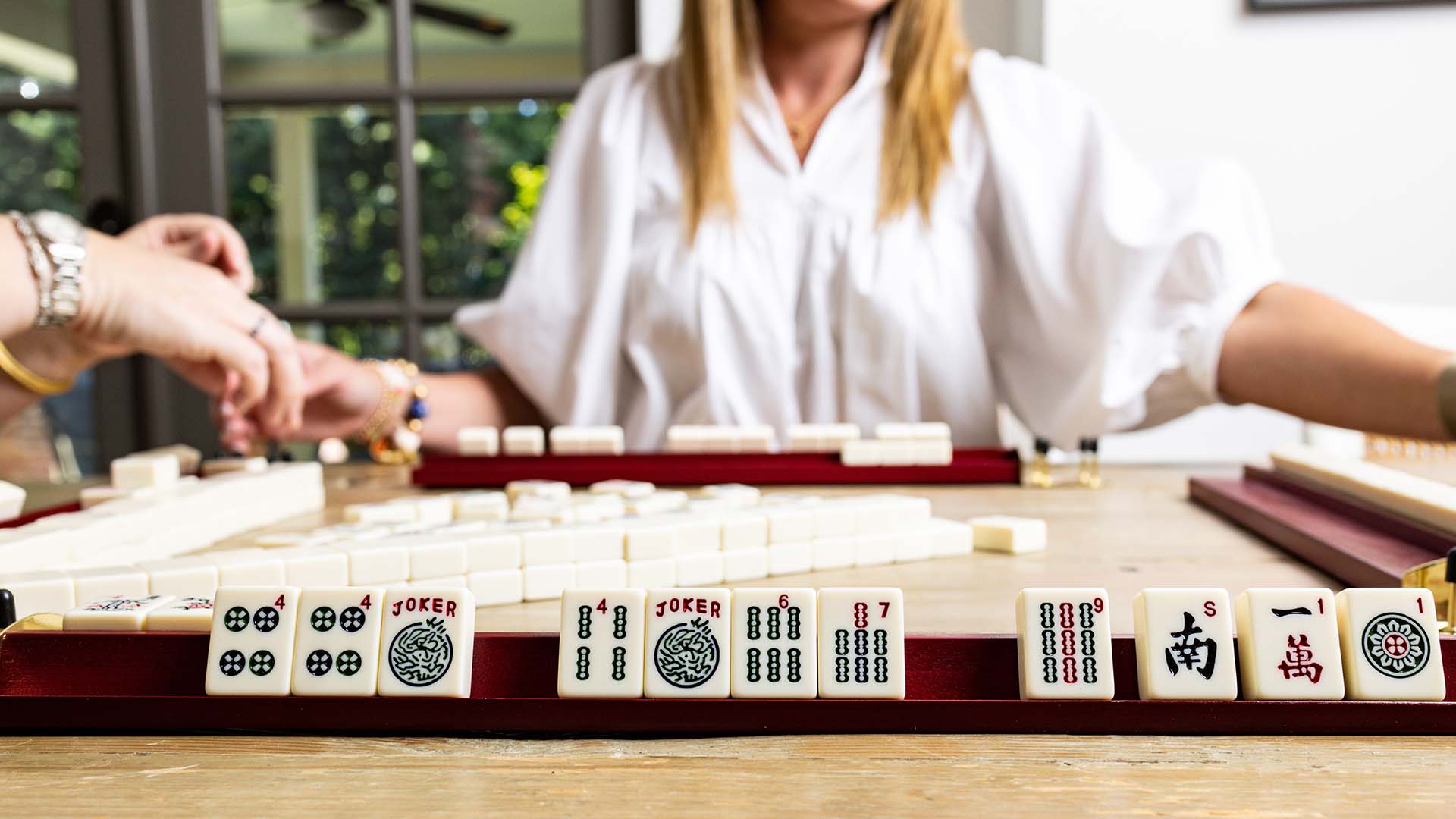
With clinking tiles and shifting rules, mahjong brings people together for strategy and socializing.
More than one-hundred rectangular tiles shift, clinking together in a gentle rumble as they’re mixed across the table. Each tile portrays colorful images representing birds, flowers, dragons, and Chinese characters. The tiles—originally crafted from bamboo or bone—are then arranged in four wall structures to begin play. Each movement of the game is swift and expected, second-nature to seasoned players.
The game is mahjong, and its origin dates back to China’s Sung Dynasty (960–1279 AD). Through ebbs and flows in popularity, the game has maintained a quiet presence among players for its strategic play and mystic allure. Featured in Amy Tan’s novel The Joy Luck Club and, more recently, in the film Crazy Rich Asians, mahjong may be making another comeback as groups are popping up around the Upstate.
Meredith Glenn, a local mahjong enthusiast, grew up watching her mother and her friends handle the sturdy, smooth domino-like pieces. Brought together by the game, her mother’s friends shared more than a friendly rivalry. Mahjong encourages a sense of community and forges a friendship between its participants. The game was passed from Glenn’s grandmother to her mother and then to her and her siblings. Years later, when a Greenville friend brought up the game on the tennis court, Glenn was struck by the idea of assembling a local group of women to play.
Glenn recently gave a mahjong presentation for the National Charity League and explained the rules of the game. “It requires time and patience to learn,” she says. There is a strategy to the game that Glenn loves. “It’s not all just luck. You really have to play it.”
In a mahjong round, players pick up tiles and try to accumulate four sets of tile combinations (three of a kind or a straight of three in the same suit, plus an extra pair.) Whoever can complete a hand (dictated by the card released each year by the national game organization) shouts, “Mahjong!” and ends the round. The winning hand is awarded points based on difficulty and the perceived beauty of the tiles themselves. For example, dragons often hold more prestige than bamboo or flowers. The game is defensive and highly strategic, as players anticipate their opponent’s moves and constantly visualize and reevaluate a winning hand based on the tiles played.

Mahjong originated in China, but it’s unclear who created the first version of the game. Some believe it was the Chinese royalty or the concubines of the Royal Court. Others say it was invented by a Chinese general on the battlefield to entertain weary troops. Regardless of its exact origin, the game of mahjong spread like wildfire.
In 1920, businessman Joseph P. Babcock became fascinated by the game after a trip to China. He brought back several sets of tiles to the U.S. and wrote an instructional manual titled Babcock’s Rules for Mah-Jongg: The Fascinating Chinese Game. From that point forward, mahjong became a stylish pastime for America’s upper class.
The game’s journey didn’t stop there. Today, hundreds of versions exist, including Old Style, European Classical, Canadian, Australian, British, and Riichi mahjong.
Beyond the perplexing rules and countless mind-boggling versions, groups across the world find joy in the ancient tiles and return to the game again and again. “The intricacies of mahjong are sweet and fun,” Glenn says. The beauty and allure of the tiles matched with the challenging and competitive spirit of the game captivate those who are willing to learn it.
History of Mahjong
- Sung Dynasty (960–1279 AD) – A Chinese game called Ya Pei originated. Its wood and ivory tiles likely inspired mahjong.
- Ming Dynasty (1368–1644 AD) – Ma Tiae, a version even closer to modern mahjong, was created.
- Late 19th century – A version of mahjong, as we know it, was created.
- 1920 – Joseph P. Babcock introduced mahjong to America with his book Babcock’s Rules for Mah-Jongg: The Fascinating Chinese Game.
- 1937 – The National Mah Jongg League was formed.
- 1949 – Mahjong was banned in the People’s Republic of China because of its association with gambling.
- 1985 – The prohibition in China was lifted.
- 1993 – Mahjong appeared in the film The Joy Luck Club.
- 1999 – The American Mah Jongg Association was formed.
- 2018 – Mahjong was featured in the film Crazy Rich Asians.

The Tiles
There are 144–152 tiles used. Each tile is elaborately decorated with symbols or Chinese characters.
Suit Tiles
- Bamboos (called “bam”)
- Stones (called “dot” in the American version)
- Characters (called “crak” in the American version)
Honor Tiles
- Wind (east, south, west, and north)
- Dragons (red, green, and white)
Flower Tiles
- Four flowers: plum (east wind), orchid (south wind), chrysanthemum (west wind), and bamboo (north wind)
- Four seasons: spring, summer, fall, and winter (when the flowers bloom)
Joker Tiles
- 8 tiles used in the American version

Versions of Mahjong
- American – Similar to Gin Rummy
- Chinese – Designated by China’s State Sport Commission as the 255th sport
- Hong Kong (or Cantonese) – Most popular version and very similar to the American version (without the joker tiles)
- European Classical – Based on the Chinese version
- Taiwanese –Contains several unique rules
- Riichi (or Japanese Modern) – Used in tournament play
Source:
https://entertainment.howstuffworks.com/leisure/brain-games/mahjong1.htm


