
Tradition inspires the unique style of Iron and Oak Duck Calls
IN A DUCK BLIND SOUTH OF EDISTO a single quack rasps across the Chehaw River. Yesterday’s cold front left the morning air crisp and dry. There’s another short burst of breath through wood and reed—louder, sharper this time—to call ducks from farther away. The water mirrors dawn-lit cumulus clouds and there, reflected in the rippled surface, is a shadow of movement across the sky.
“The first time you call a duck, it really strikes a chord,” says Christopher Williamson, co-owner of Iron and Oak Duck Calls. “He’s heard you, and he’s coming to you. You’ve connected with nature. You go out there thinking you’re just going have fun one morning, and next thing you know, you’re hooked.”
Iron and Oak: Inspired by Tradition
Williamson and co-owner Logan Kanipe turned their “addiction” into a business. They make heirloom duck calls inspired by tradition, friendship, and a shared love of hunting.
“For me, hunting is about connecting with the past,” says Kanipe. “Chris and I love the historical aspects of call making. Even though we’re using more modern woods and mylar reeds and such, we get a lot of our inspiration from traditional call-makers like Charles Perdew.”
Williamson holds up an antique call, adding, “This was made by Tom Turpin in the 1940s. Turpin was just an incredible craftsman. It still sounds amazing, but I would never hang that on my lanyard. It’s a showpiece now. There’s a lot of history in it.”
Closely Guarded Secrets
The more Williamson and Kanipe used and collected duck calls, the more they wanted to make their own, but there was a catch. “There are no how-to manuals or YouTube videos out there,” says Kanipe. “You can learn how to use hand tools or turn a lathe, but there’s nothing out there about getting the sound right.”
Historically, families also concealed techniques of the trade. “Back in the late 1800s and early 1900s, call-making was a family business,” explains Williamson. “When a family came up with a technique, that secret would be closely guarded and then passed down from generation to generation.”
Absent information meant the duo had to reverse engineer the calls. The “maddening thrill” of trying to figure out the secret drew Williamson and Kanipe deeper into the art form. “You spend so much time trying to figure something out,” says Williamson, “Then the barrel just breaks down the middle of everything, and you’ve got to start over. Or maybe the shape is beautiful, but the sound just isn’t right.”
Months of experimentation led to eventual success and an ever-deepening respect for bygone masters. “We made a lot of firewood!” jokes Kanipe.
Williamson and Kanipe collaborate on every Iron and Oak duck call. “We’re sounding boards for each other,” says Williamson. “We figure out the sound we want. We sketch out the models together. I’ll turn some on the lathe, and Logan will turn some. Then we swap and mess with the reeds or whatnot.”
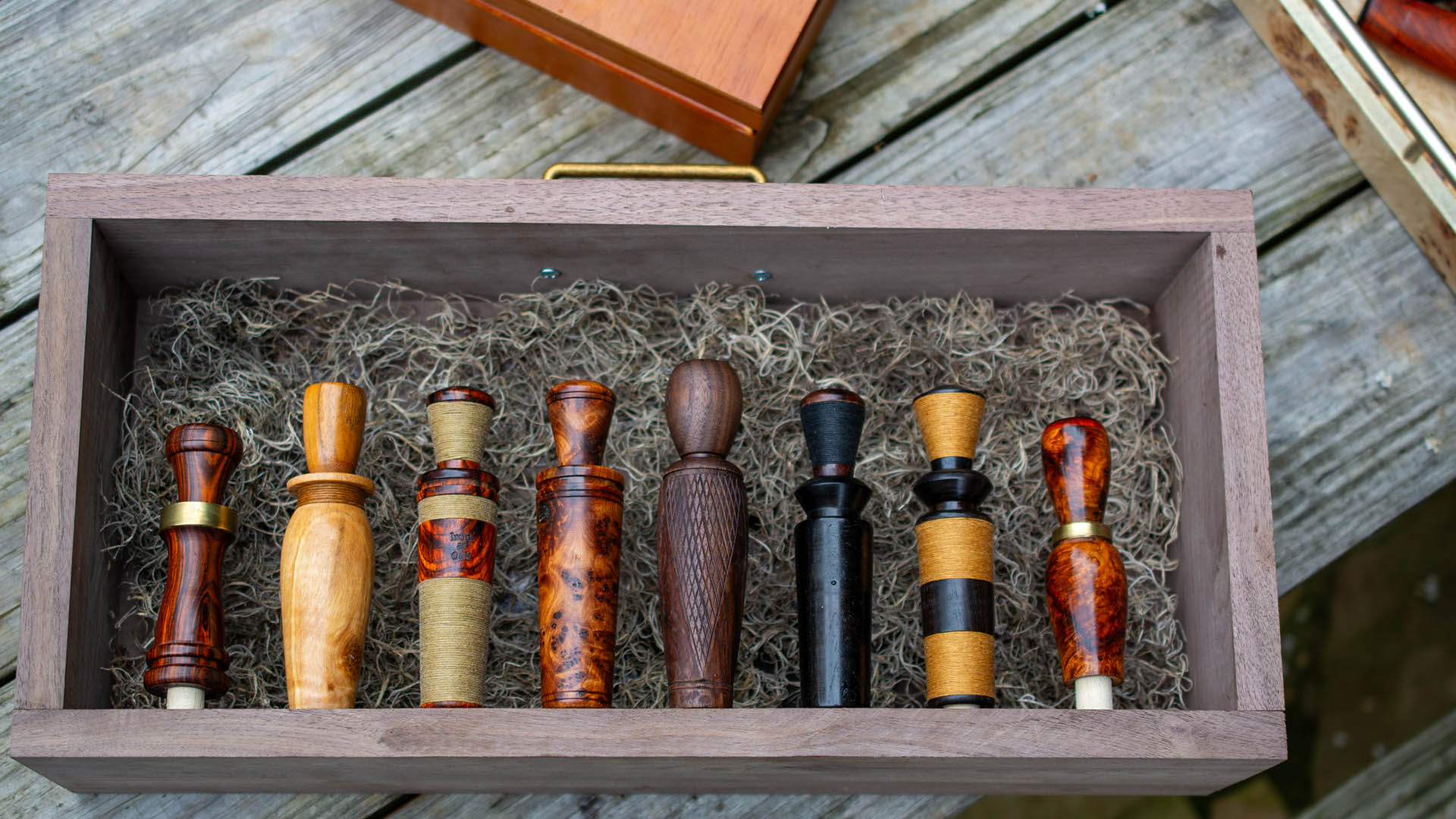
The result is a series of designs inspired by tradition but unique to Iron and Oak. Models range from the elegantly simple Gentleman, Beaverdam, and Swamp Angel to the more elaborate Suzie, which resembles a chess piece. Each one, says Williamson, has “nice curves and attention to detail.”
There’s the Elder with its smooth lines and waxed cotton twine. There’s the Chehaw River model, with its short barrel and shapely form. Each model comes in a variety of woods, including African blackwood, green hedge, cherry, or Osage, each with its own color and grain.
“The softer the wood the softer the sound,” says Williamson. “The harder the wood the louder and sharper the sound.” Likewise, the size and shape of the body also affects tone. “A longer barrel gives you a deeper sound. A shorter barrel gives you a higher, sharper pitch register.”
Form and Function
Like all pieces of folk art, well-made duck calls possess inherent tension between aesthetics and practicality.
“Our calls are built to be used,” says Kanipe. “And they’re built to last. The woods are very durable. But still, they get dinged up and scratched . . . . It gives them character.”
A duck call is a tool, and tools are meant to fit in your hand. “They’re like musical instruments,” says Williamson. “You want to pick one that suits your needs, but you also want one that you like the looks of . . . . There’s definitely a sense of satisfaction in making something beautiful. Something that sounds great.”
Iron and Oak Duck Calls
- Together, Williamson and Kanipe make up to three duck calls per day.
- They range in prices from $175 to $450 for smaller-batch calls.
- Each is unique, and all are tested for sound quality.
- Shop online at ironandoakduckcalls.com.


