
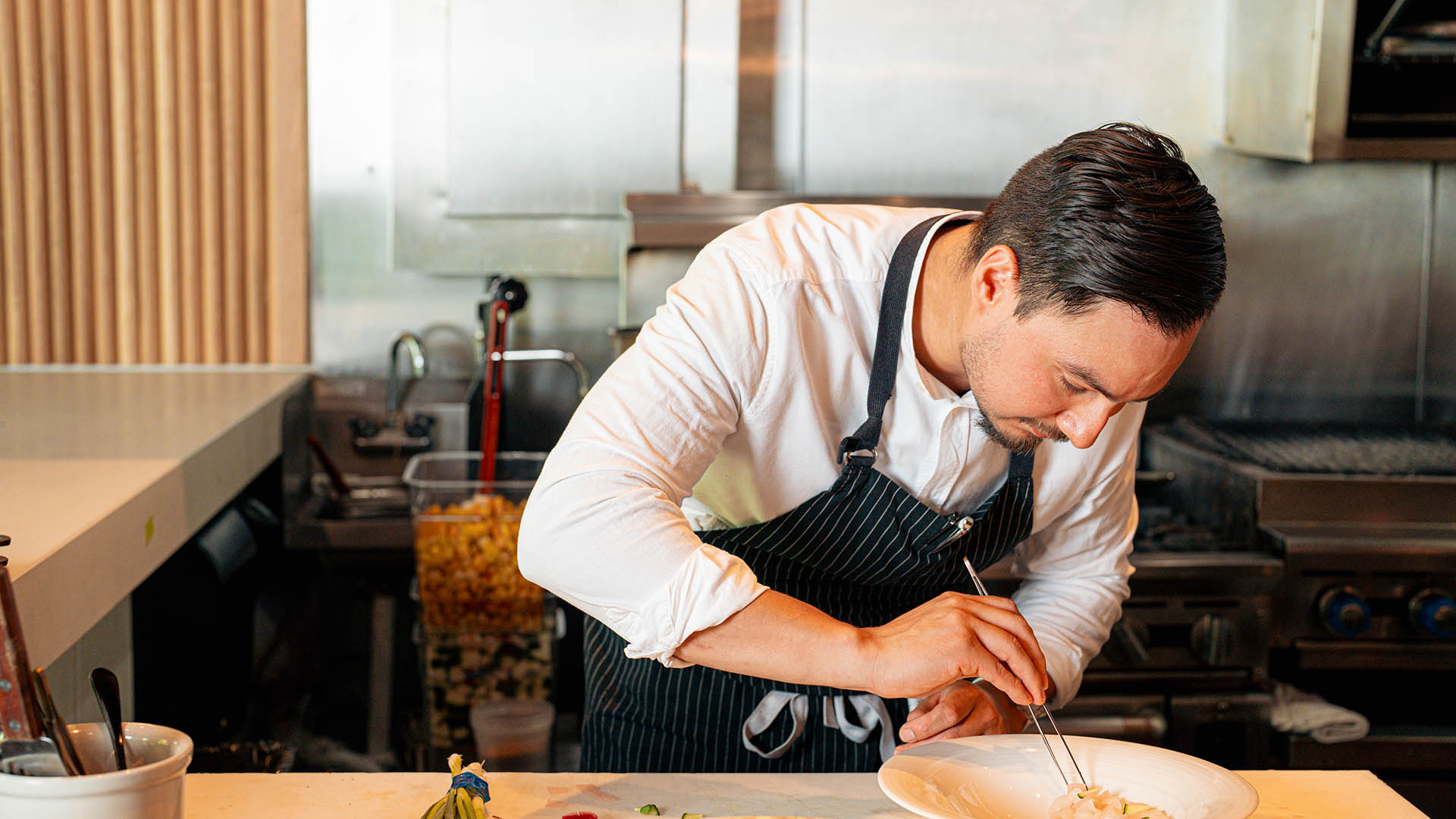
After Diego Campos received his associate culinary degree and B.A. in business administration at Bob Jones University, he set his sights high. “A personal goal of mine was to be a chef de cuisine before I turned 30,” he shares. Now 31 and newly appointed chef de cuisine at CAMP following Executive Chef Drew Erickson’s departure, Campos is only a year off his target.
Campos, who helped Erickson open CAMP in 2021, moved to Greenville with his family from Puebla, Mexico, at age 11. Fueling his interest in building and design, he initially studied architecture in college, but eventually pivoted to cooking as a career. “Both architecture and cooking have that creative aspect, and that’s what pushes me personally,” Campos says. “I need to touch something, to do something. I cannot sit still.”
The youngest of three boys, Campos spent many hours helping his mother in the kitchen. They bonded watching the Mexican version of the Food Network and challenging each other to identify the ingredients of a particular dish when the family went out to dinner. In 2013, he launched his culinary career at Passerelle. From there, he came up through the Table 301 group, cooking at the Lazy Goat before landing at CAMP.
CAMP bills its menu of small plates as Modern American, but in the widest sense. “America is a big melting pot of cultures and they each bring their own dishes,” Campos explains. Thus, the changing menu is peppered with global flavors in offerings like Spanish-inspired skirt steak skewers, pork and shrimp dumplings, and tuna tostadas. “I am not committed to one type of cuisine,” says Campos. “We look at other cultures and see if we can adapt the dish to what we have right now growing in Greenville. It’s a lot of playing around with the seasons, playing around with what works well for this time of year.”
The chef’s wanderlust fires up ideas for CAMP’s menus. A backpacking trip across South America, a driving tour of Scandinavia, and a trip to Turkey have all fueled the culinarian’s creativity. “Right now I have in my head a dish—provoleta—that we had in Argentina,” he shares. “It’s a big chunk of provolone cheese that they hard-sear on cast iron, so it’s melting on one side and the other side is firmer. I ate that about four months ago and am still thinking about how can I make it at CAMP.”
While it’s likely that provoleta will appear on the menu in the near future, count on Campos to tweak it in his own distinctive way, holding fast to the restaurant’s ethos of using seasonal ingredients and supporting local farmers. He recounts that in Argentina provoleta was served with sun-dried tomatoes, arugula, and fig vinaigrette. How they recreate it at CAMP will depend on the time of year. “If it’s winter, we’ll go for stronger flavors, balsamic vinegar or saba, sweet potato puree, maybe.”
At the same time, it’s important to Campos to express his Mexican heritage through his cuisine. He sees food as the bridge to teach others about his culture. “You make something delicious, and people will be interested in learning more about it and the culture behind it. That’s when I start teaching about different products, and the history of Mexico, and why we started eating this.” People, he points out, don’t realize how difficult and labor-intensive Mexican cuisine is. Case in point is mole, a sauce marked by complex layers of flavor. To start, perfectly ripe chiles first must be dehydrated, then ground into a powder—and that’s just one ingredient of a mole.
“I’m very happy and thankful for this opportunity,” Campos says proudly of his new role. “The culture we’ve been able to create here with Chef Drew, and now with me, is great. Everyone on the team has the same goal in mind: taking care of the guests. We work really hard on maintaining CAMP’s culture.”
Making the Connection
From his years working alongside Drew Erickson—whose resume includes four years at Thomas Keller’s three-Michelin-star restaurant The French Laundry in Napa Valley, California—Campos has picked up many valuable lessons.
The most important thing he learned from Erickson? “Taking care of the guests,” he says. “I enjoy hospitality, but Drew has this talent of connecting with the guest [at the chef’s counter] and making that person feel like the most important person in the world at that moment. I’m trying to be more like that.”
CAMP, 2 E. Broad St., Greenville, 864.514.2267, campgvl.com
CAMP Steak Pinchos Recipe
From Chef de Cuisine Diego Campo, CAMP
Yield: 20 1.5 oz skewers
Steak Skewers
- 2 lbs skirt steak
- 20 bamboo or metal skewers
- 2 cups marinade (recipe follows)
- Slice skirt steak into ¾-inch-thick strips about 3 to 4 inches long, making sure to cut against the grain. Remove any undesired silver skin or excess fat from the cut of meat.
- Make the marinade (see recipe below).
- Pour marinade over skirt steak strips and allow to marinate for at least 4 hours.
- If using bamboo skewers, soak skewers in water for at least 1 hour. This will help to minimize the burning of the wooden skewers while on the grill.
- After meat has marinated for at least 4 hours, thread the skirt steak strips into the skewers.
- On a hot grill, cook the skewers for about 2 minutes on each side for a good medium. If you prefer medium-rare, adjust time to 2 minutes on one side and 1 minute on the other side.
- Enjoy with a side of crispy potatoes and dijonnaise or chimichurri sauce.
Marinade
Yield: 1 pint (roughly 18 oz)
- 1 cup soy sauce
- 1 cup fresh lime juice
- 2 Tbsp ground ginger
- 1 Tbsp ground coriander
- 1 Tbsp ground cumin
- 1 whole large shallot
- 8 cilantro stems, with leaves
Instructions
Place all ingredients in a blender and blend until smooth. This should take about 20 seconds, starting on low and working your way up to high speed. Remember that the marinade includes soy sauce, which contains a good bit of salt. When grilling or cooking, be careful not to season with more salt, as marinade could become too salty.
Chef’s Note: The marinade can be used for multiple proteins. Use with skirt steak, hanger steak, flat iron, or diezmillo (sirloin). It can also be used with chicken breast, pork chops, and pork tenderloin. Ideally, you want to marinate the protein from 12 to 24 hours. This marinade is so flavorful that you can refrigerate it and use a second time for marinating the same type of protein. Discard after 5 days.


