
Former college professor Sandra Greer demystifies chemistry for the home cook
Suppose you were one of those students who avoided taking chemistry because you figured it had no practical applications. In that case, you may be surprised to learn that chemistry plays more than a cameo role in everyday life—starting in the kitchen.
Just ask Sandra Greer. The retired chemistry professor recently penned a book on the subject, called Chemistry For Cooks. Chemistry was a natural career path for Greer, who describes her young self as a “nerdy science kid.” “From the time I was 4 or 5 years old, I wanted to know what things were made out of,” she says.
Though written as a textbook, Greer’s 2022 work is equally accessible to lay readers who don’t know an atom from a molecule. “I tried to make it as easy to read as possible,” says the Greenville native who now lives in San Rafael, California. I wanted my [teenage] grandchildren to be able to read the book. Both of my sons—neither of whom is a scientist—have read and used it. It’s meant to be a handbook to be used in the kitchen: get stains all over it, turn down the pages, write in it.”
Greer hatched the idea for Chemistry For Cooks years ago when she was provost at Mills College in Oakland, California. “A lot of students think they’re not interested in science, so I wanted to construct a course that would interest that group. Everybody needs to eat and everybody’s interested in food one way or another, so I used cooking as a way for them to learn chemistry in a painless way . . . that they could use in their lives. After I retired, I took my notes from the course and wrote this book.”
What makes baked goods rise? How does adding salt speed the cooking of vegetables? Why should you add a pinch of baking soda to dried beans when you cook them? Greer’s book answers all these questions and many more. Each of the 14 chapters includes two recipes to illustrate the scientific principles she discusses. Many of those, like her mother’s recipes for collard greens and fruit cobbler, were handed down from her family.
While you don’t have to know much about chemistry to be a good cook, it certainly helps. “When you understand the basics of how things work, you’ll have ideas about other ways to do something. [That knowledge] also makes you braver in the kitchen,” explains Greer.
Turns out, cooking is just one big chemistry experiment.
Kitchen Chemistry Recipe
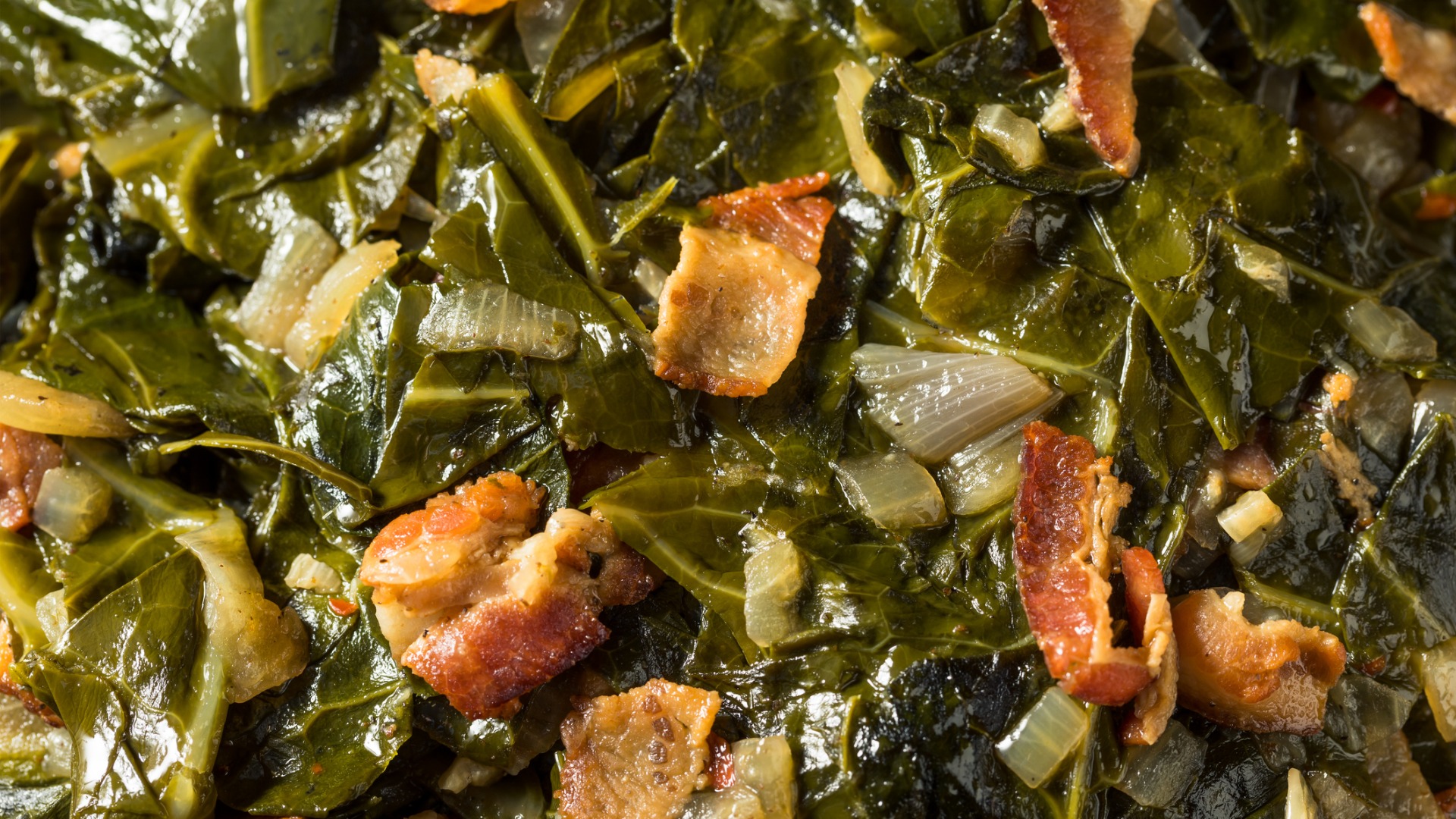
Collard Greens, adapted from Louise Childress Thomason
From Chemistry For Cooks, by Sandra C. Greer
Yield: 4 servings
Author’s note: This recipe is from my mother, a classical Southern cook. Her old-time method cooks the greens for a long time so that they reach a soft texture and produce a lovely broth or “pot likker.” This also works for other kinds of greens, such as turnip greens or beet greens. Collard greens can be grown in the home garden, even in the winter in mild climates, and provide fiber, vitamins, and minerals to the diet.
Ingredients
- 2 pounds (1 kilogram) fresh collard greens
- Water
- 6 strips bacon
Instructions
- Fresh collard greens need to be washed carefully to remove any soil. Fill the sink with water, put the greens into the water, and rinse each leaf.
- Tear the leaves from the ribs and into pieces about 3 inches around. Put all the torn leaves into a large pot and add an inch or two of water.
- Put the pot on the stove burner and bring the water to a boil. Cover the pot, reduce the heat to a simmer, and cook the greens for about an hour. Taste the greens to see if you are satisfied with the texture or if you want them to cook longer.
- Cook the bacon in the microwave: Put a layer of paper towel on a plate, put the bacon on the paper towel; put another layer of paper towel over the bacon, cook on high until the bacon is crisp (about one minute per strip of bacon). Break the bacon into small pieces.
- Remove the greens from the water with tongs and put them into a serving bowl. Sprinkle the bacon over the greens.
- Serve with a pickled relish on the side.


