
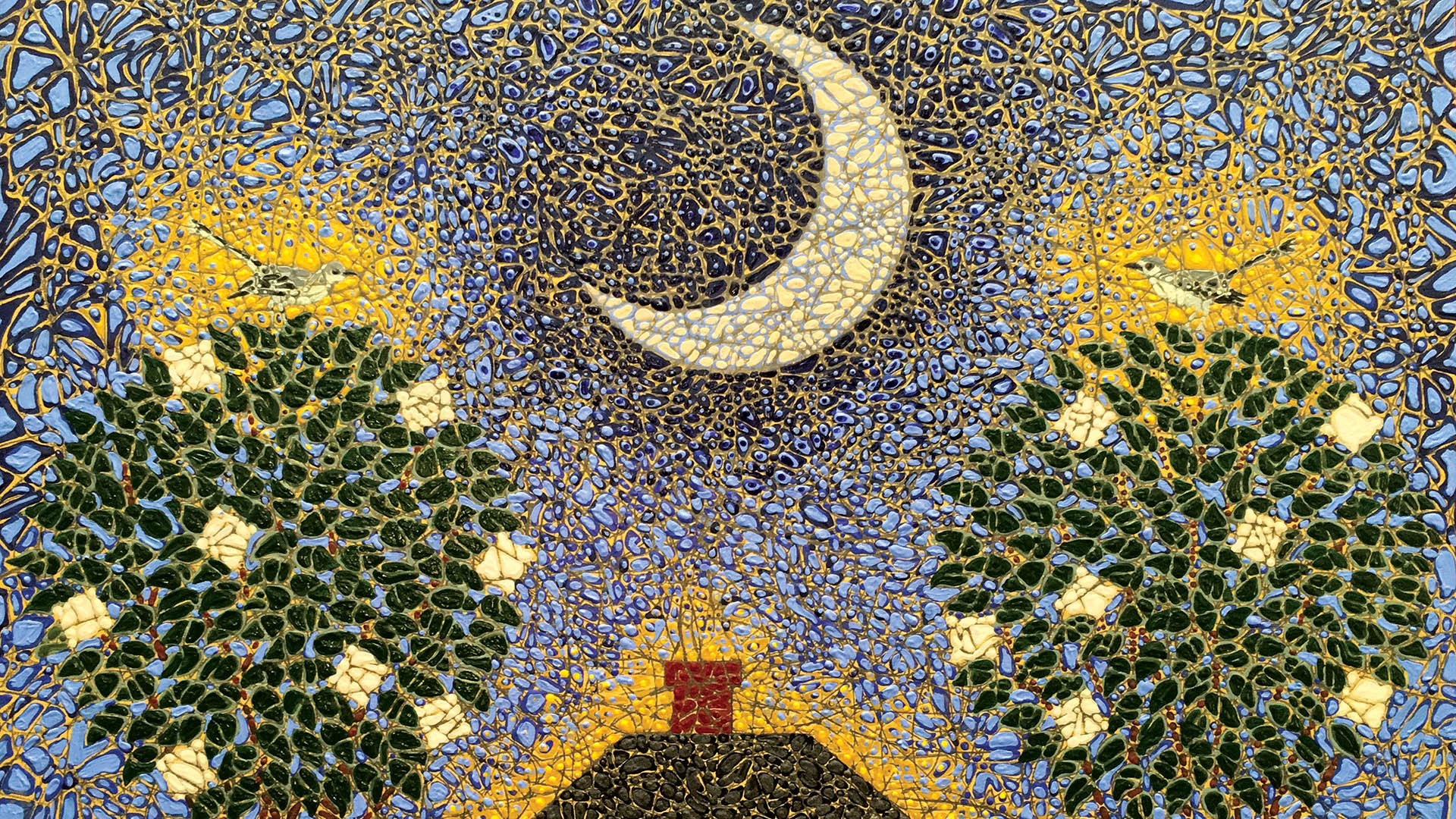
There is an unspoken duality pulsing through our thick air, centered around metaphor and ultimately the pursuit of universal truth.
If duality and metaphor are part of the Southern identity, artist and curator Paul Matheny is a son of the South. As a young boy, Matheny crossed paths with sign painters at his grandfather’s Gulf Station in Belton, South Carolina. He honed his interest in folk and “outsider” art while an undergraduate art student at Winthrop University, often traveling the backroads of South Carolina to seek out these makers and amplify their work. Since arriving at the South Carolina State Museum in 2002, Matheny has held multiple curatorial roles, and is now the museum’s director of collections.
Matheny’s art, much like Southern culture, is representative of the convergence of simplicity and complexity, of “outsider” and intellectual.
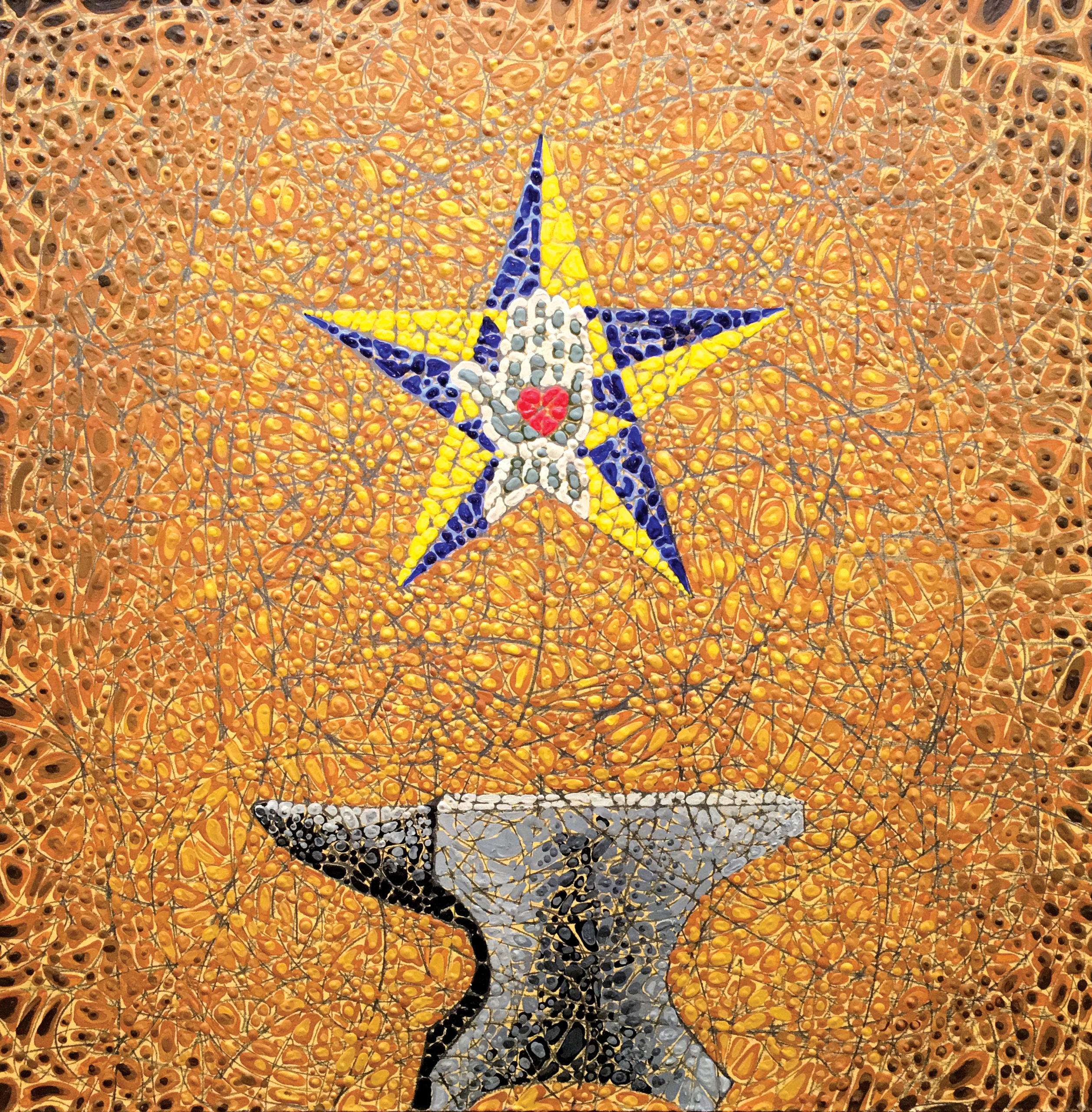
His passion for folk art collides with his academic fine art background to create a system of elusive symbols whose meanings are both personal and subject to the viewer’s lived experience. Matheny’s pared-down compositions conflict with the laborious process behind them.
Beyond the Surface of Folk Art
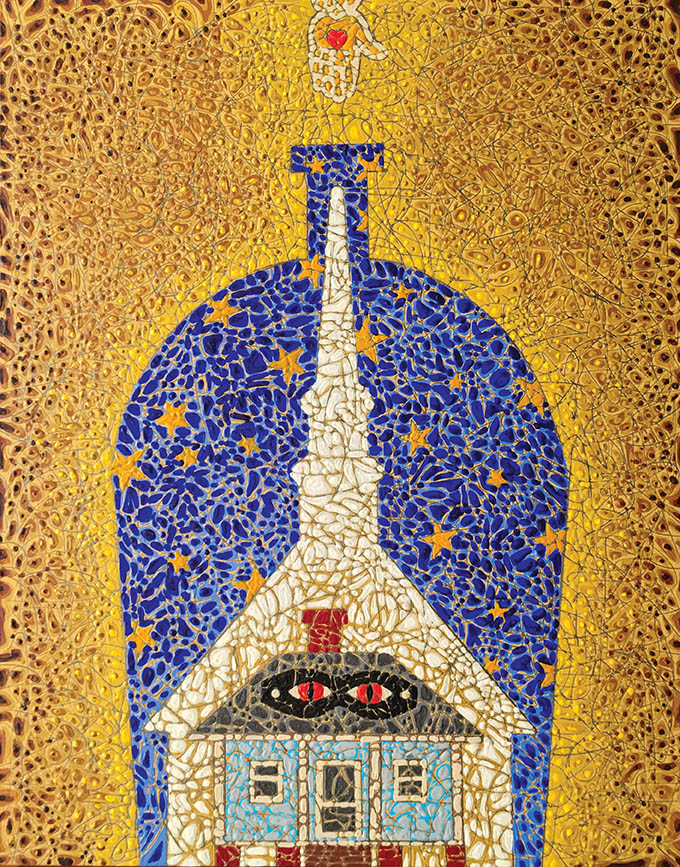
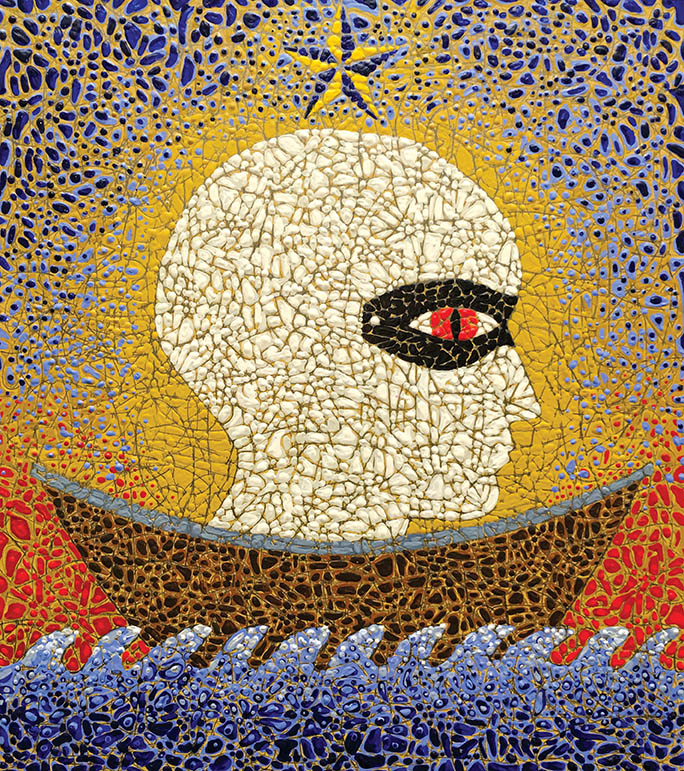
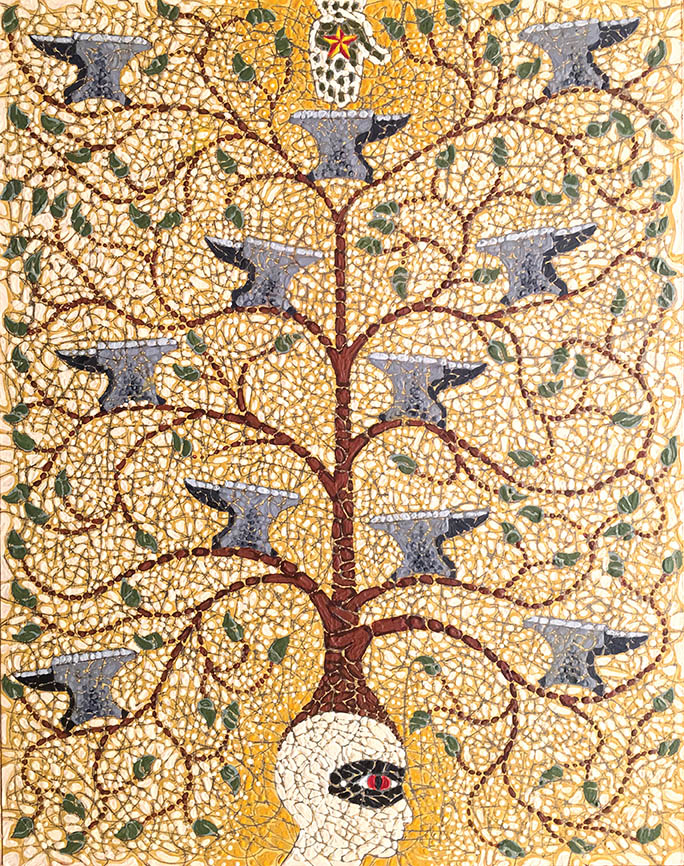
He begins with stream-of-consciousness writing directly on the painting’s surface, which he compulsively repeats until small swaths of negative space form. He then superimposes his iconographic symbols onto the writing matrix and fills in the negative space between the lines. The result is dimensional, textural work reminiscent of both Byzantine mosaics and roadside fortune-teller signs.
Snakes, pigs, stars, and masks make frequent appearances in his compositions. These icons, taking a lead from traditional portrait silhouettes, have volume despite their flatness, and mystery despite their simplicity.
His latest body of work, most recently exhibited at Hampton III Gallery in Taylors, uses his “Search for Truth” series begun in the 1990s as a point of departure. “These current paintings, while still connected to each of the previous pieces, have evolved to reflect a more ethereal, transcendental thought process . . . the viewer is invited to bring their own perspective into the image, allowing them to personally connect with the narrative in their own way.”
Matheny’s symbols are fused together in compositions that convey dream-like “visions” to which we can all relate. Vision as related to spiritual awakening is a widely investigated theme in Southern literature and art. Eudora Welty, acclaimed writer and photographer, wrote a Pulitzer Prize-winning novel in 1972 titled The Optimist’s Daughter.
The protagonist’s father dies after complications from eye surgery, and as the story unfolds, she begins a process of self-discovery after spending time with people of her past. The prominent metaphor is vision, and Welty equates the ability to see with the ability to understand. Much like Welty, Matheny calls into question the objectivity of sight relative to universal truth.
Who sees best?
Who is closer to spiritual enlightenment? After spending time with Matheny’s work, it seems that Southerners are outsiders, challengers of worldly intellect, and transcendentalists who are most equipped to find universal truth. Matheny, through his mystical visions, alludes to the duality at the core of the Southern condition, suggesting that subjectivity, rather than objectivity, is the key to understanding the human condition.
To view more of Paul Matheny’s work, go to hamptoniiigallery.com.


