

An astrophotographer’s journey to the deep night sky.
“Space is very chaotic,” David Quattlebaum says, standing outside next to one of his telescopes. “There’s not much order to it. Even the straight lines aren’t really straight lines.”
Quattlebaum’s path from his family’s farm in Pendleton, South Carolina, to art school in Baltimore, Maryland, and back to the Upstate to run a software company hasn’t been a straight line, either.
“I started taking art lessons in middle school, but I was always into science, too,” says Quattlebaum. “Even as a kid, I was interested in big questions. And space, space was unfathomable.”
Behind him, the sun sets, silhouetting the tall trees surrounding his backyard.
The Night Sky Brightens
As twilight fades to dusk, the sky grows bluer. Venus reveals herself.
“This is my Wide Field Rig,” he says. The setup includes a William Optics RedCat51 300 MM scope with a ZWO 294 MC Pro cooled sensor camera at one end and a smaller guide scope on top. Camera and scopes rest on a large, white tracker mount. “This is small, but it gives me a broader view of the night sky.”
The guide scope and mount align with the North Star. As the Earth moves, the mount compensates by rotating slightly in the opposite direction, preventing blur and giving the impression of stillness in the image seen through the telescope.
Space & Art Converge via Astrophotography
“When I was 10, we went to the Smithsonian’s National Air and Space Museum,” Quattlebaum says. “This was right when Voyager was going past Saturn. And looking at these pictures of this thing—this planet—just floating out there. It was just so beautiful.”
“I really wanted a telescope, but we just didn’t have money for one. So, I just kind of let it slide by.”
After high school, he attended the North Carolina School of the Arts and the Maryland Institute College of Art. He bought and curated the Sheppard Art Gallery in Ellicott City, Maryland, and founded the Opal Galleries in Pendleton, South Carolina. He became a software developer. But the “big question” of space would remain unanswered, itching at the back of Quattlebaum’s mind.
Orion Rises
In the summer of 2017, Quattlebaum found himself looking toward the sky again.
“I was super excited about the solar eclipse,” he says. “I told my wife, Alysen, that I would just love to have a big telescope. She was like, ‘Just go buy one.'”
Quattlebaum bought a telescope that was as tall as he was, and he “started looking for stuff.” The fun was in the finding.
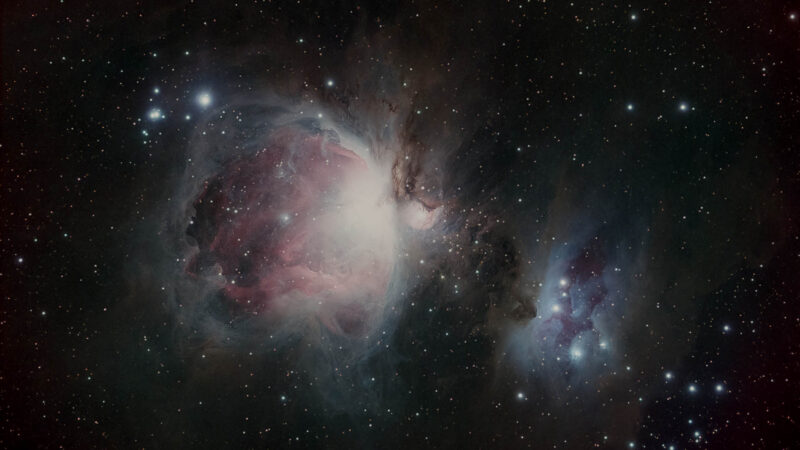
“That very first night I tried to find the Orion Nebula,” he says, “I knew enough that I could triangulate my way around. I’m looking around, and all of a sudden, I can see the nebula. Right there in my eyepiece! I’ve just found a deep sky object thousands of light years away with this telescope in my backyard. It was a huge sense of awe.”
Saturn Returns
 “Then I realized I could look at Saturn,” he says. “I remembered those pictures back at the Air and Space Museum and I looked through the eyepiece, and . . . I welled up with emotion. It’s real. There’s Saturn. There’s space in total order!”
The more Quattlebaum looked, the more he discovered. Planets and stars aligned, shifted, and realigned, but the moments of totality, of order, of discovery, thrilled him.
“There was the culmination of many years coming together,” he says. “I felt like, ‘This is me. I’m experiencing this personally. A decades-old question is getting answered.'”
Composing the Whirlpool
Toward the back of his yard, Quattlebaum has his Galaxy Rig—a larger scope for farther away targets—set up next to a card table, laptop, and chairs. This will be the third night in a row shooting the Whirlpool Galaxy.
Tonight, he will take at least 60 three-minute exposures. Tomorrow, he will select the best exposures and “stack” them on top of each other in Pixinsight and Photoshop. Stacking reduces digital noise, deepens the field, and increases sharpness.
It All Comes Together
 Under the dome of the Upstate sky, Quattlebaum sees the universe in color and light, patterns and forms. He moves between telescope and laptop in a meditative workflow, careful to avoid power cables, tethering cables, and the tripod. The process is inherently joyful and optimistic for him.
“I can see into my future,” he says. “There is some destination where all of these things—painting, software development, astrophotography—connect, where they all work together as a singular thing. I would hate not to have that feeling.”
Once the setup is complete, he presses a laptop key to initiate the first of many three-minute exposures, leans back in his garden chair, and stares up at the night sky.
“Now, we wait,” he says.
Roper Mountain Astronomers
Astronomy does not have to be a solitary pursuit. Quattlebaum serves as president of the Roper Mountain Astronomers, which meets the third Thursday of the month at the Charles E. Daniel Observatory at Roper Mountain Science Center.
The Observatory is home to a 23″ refractor telescope built in 1882 by Alvan Clark and Sons of Cambridge, Massachusetts, for Princeton University. The telescope was rebuilt by J. W. Fecker Company in 1933, moved to the U.S. Naval Observatory from 1964 until 1978, and donated to Greenville County Schools in 1968.
Membership numbers have increased during Quattlebaum’s tenure, largely through expanded school outreach programs and more frequent in-person gatherings.
“Astronomers tend to be open and friendly,” he says. “They love to share what they know and to help out newcomers.”
Monthly star parties often include as many as 30 people. Astronomers of all ages view targets through the Club’s 14-inch Schmidt Cassegrain telescope or set up their own gear. Summer star parties are scheduled for each weekend approaching the new moon, weather permitting.
For more information about Roper Mountain Astronomers or to join the club, go to rmastro.com.


